All cars are not created equal – and when you’ve got a Lamborghini or an Aston Martin glittering in your garage, you’ll want to give it the best treatment you can. No doubt you’ll invest in regular servicing and give it a good wash and brush-up whenever it needs it, but there is an avenue that tends to be overlooked - breakdown cover.
The Best for the Best
Expensive and prestige cars are designed and manufactured with that extra attention to detail. High-end specifications and immaculate production standards are what set your car apart from the rest of the crowd. When it comes to the cost, you’re paying for something that delivers outstanding performance, as well as the satisfaction of knowing it turns heads as fast as it turns corners.
Because of the cost, these prestige cars are relatively rare on the roads and this sets them apart from the general traffic in both physical and financial terms. By paying for a high-end car, you’re going to find that your insurance premiums are higher, reflecting the increased risk that they represent to insurance companies. However, given that your pride and joy is also going to be subject to wear and tear and the unscrupulous designs of others, you’ll need to give yourself the best protection you can.
Breakdown without a Breakdown
Your general insurance is going to reflect the cost of your car as much as your driving history. However, there are some things that are completely beyond your control such as mechanical failure or the effects of the elements on certain components. Breakdown cover gives you the security of knowing that, if your car does break down, you’re not going to be stuck on the side of the road or have to pull out all the stops in hunting out a specialist garage.
Because your car is a specialist product, it will require specialist breakdown cover which, in turn, is going to cost more than the average policy. However, with the insurance market becoming ever more competitive, the Internet can help to yield surprisingly cost-effective rates. It’s also worth remembering that, just as your car stands out from the crowd, so too will the levels of service you can expect from your breakdown cover. By shopping around for breakdown cover that deals with top-of-the-range cars, you can also find policies that offer top-of-the-range provisions for premium customers. This might include accommodation in the event of a breakdown or much faster response times. Look at the perks and incentives offered by each company to find which suits you and your motor the best.
If the idea of trawling the Internet for policy details is too much to think about, bear in mind that online comparison sites are a quick and convenient way of finding out just what’s available. These sites are independent data-collators, which present all the information you need in an easy-to-read format, allowing you to quickly find out which is the best policy for you.
A luxury car is a major investment. Taking a little time to hunt down the best breakdown cover can prevent that investment from turning into a money pit.
sponsored post
Thứ Sáu, 27 tháng 5, 2011
Chủ Nhật, 8 tháng 5, 2011
Jaguar to partner with Williams F1 to create hybrid supercar
Jaguar announced last week that they were going to develop the Jaguar C-X75 in association with Williams F1 who will provide their engineering expertise in areas including aerodynamics, carbon composite manufacture and hybrid technologies. The production of this hybrid supercar will be limited with only 250 built.

This is the first time the two companies are collaborating to produce one of the world’s highest performance and environmentally sustainable supercars. The production of Jaguar C-X75 is expected to create more than one hundred highly-skilled jobs in the UK.
The new car will have an internal combustion engine along with electric motors and emitting less than 99g/km CO2 emissions.
The car will reach 0-60mph in less than 3 seconds and 0-100mph in less than 6 seconds with a top speed in excess of 200mph. The car will have a lightweight, all carbon-fibre chassis and prices are expected to start from £700,000.

The new car will have an internal combustion engine along with electric motors and emitting less than 99g/km CO2 emissions.
The car will reach 0-60mph in less than 3 seconds and 0-100mph in less than 6 seconds with a top speed in excess of 200mph. The car will have a lightweight, all carbon-fibre chassis and prices are expected to start from £700,000.
Thứ Tư, 4 tháng 5, 2011
Contango
And other issues not commonly understood by consumers about the world oil market
The higher the price of gas at the pump, the more sensitive consumers are to allegations of oil market price manipulation. Most consumers are unaware exactly how any manipulation takes place, but they can't square the doubling of the price of a gallon of gas when the price of a barrel oil doesn't double, so they are suspicious there is a culprit to be blamed. Oil companies become the bad guys as they report high profits.
Well there IS oil market manipulation by the most major of oil traders. AND it isn't even illegal. But it takes tremendous amounts of capital to manipulate the world market price of oil. For a variety of reasons, the best known energy trader manipulating the world market price of oil is Koch Energy, probably because of the Koch brothers high profile participation in the political process.
So what is "contango?" Contango is the strategy of purchasing large stocks of oil and storing it in offshore supertankers and giant containers, creating a shortage or exacerbating a real or perceived shortage in the market. The trading company then it sits on those supplies until oil prices rise.
Ever wonder how gas prices can be $4.50 per gallon in say July 2008, and then drop to $1.90 when President Obama was inaugurated In January 2009 six months later? Crude oil prices dropped from more than US$145 per barrel in July 2008 to less than US$35 per barrel in December 2008.
When the contango hoarders turn their stocks of oil loose on the market at the peak price, it tends to flood the market with oil, especially when consumers have cut back on consumption due to the high price. At the same time all producers pump and transport like crazy to take advantage of the high price, including those in the oil patch. The end result is a glut and cheap fuel at the pump. And consumers end up with fuel price volatility. U.S. consumers tend to think they are entitled to the "glut" fuel prices, rather than the highest price or even an intermediate price.
For those who recall, the Bass Brothers' play on silver in 1977 and 1978 was a form of contango.
But there is another example of "hoarding" on a much larger scale. OPEC has been hoarding oil for 35 years. In 2011 there are more members of OPEC than in 1973 and world wide consumption has accelerated. Yet, OPEC doesn't produce any more oil today than they did in 1973. OPEC is not in the business of just selling volumes of their finite resource, as much as maximizing the price they get for each barrel. The U.S. produces about a third of its oil domestically. We get another third from Mexico and Canada. The final third comes from OPEC. What is not clear to most Americans is that if we double our domestic production, and eliminate the OPEC purchases, we still have not freed ourselves from the world market price of oil. Why? Because Americans do not own the oil produced here, the oil company that makes the investment to find it and produce it owns the oil. The chances of an oil company selling their oil to the U.S. consumers at less than the world market price is slim and none. Yet, I don't hear a lot of talk about nationalizing the oil companies.
But there is another example of "hoarding" on a much larger scale. OPEC has been hoarding oil for 35 years. In 2011 there are more members of OPEC than in 1973 and world wide consumption has accelerated. Yet, OPEC doesn't produce any more oil today than they did in 1973. OPEC is not in the business of just selling volumes of their finite resource, as much as maximizing the price they get for each barrel. The U.S. produces about a third of its oil domestically. We get another third from Mexico and Canada. The final third comes from OPEC. What is not clear to most Americans is that if we double our domestic production, and eliminate the OPEC purchases, we still have not freed ourselves from the world market price of oil. Why? Because Americans do not own the oil produced here, the oil company that makes the investment to find it and produce it owns the oil. The chances of an oil company selling their oil to the U.S. consumers at less than the world market price is slim and none. Yet, I don't hear a lot of talk about nationalizing the oil companies.
Further, when we increase production, OPEC cuts theirs back a like amount to maintain the supply/demand balance. The graph at the following link shows the production of OPEC over the decades: (graph link)
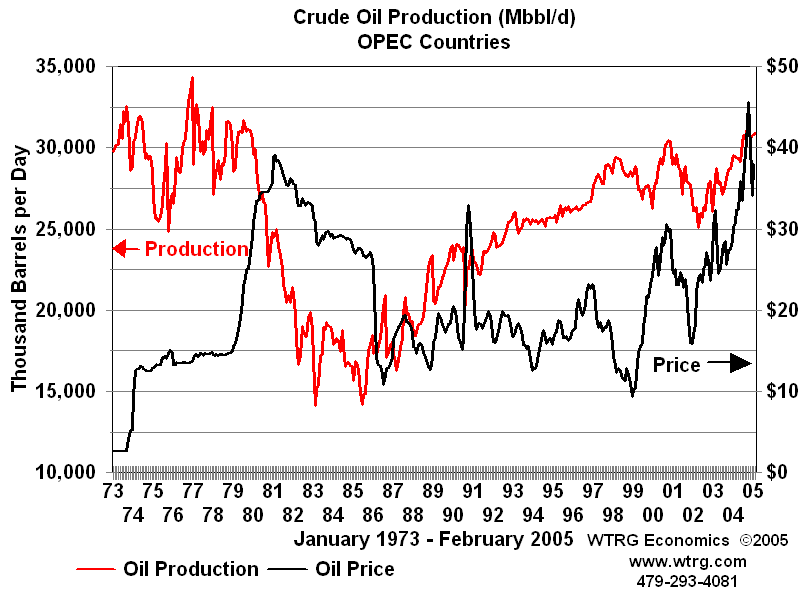
More domestic production WOULD improve our balance of payments situation, but it would quickly eat up our meager oil reserves. The U.S. maximized domestic oil production in 1970 and uses 25% of the world's production while owning less than 5% of known reserves. We ramp up production, OPEC cuts theirs back, and we use up our reserves without saving a dime. So much for “Drill Baby Drill.”
Off shore and ANWR reserves seem like a lot of oil until weighed against U.S. consumption. OPEC sits on 70 - 80 percent of the world's known reserves, to put things in perspective.
There are those who think we are better off to use up others' reserves and keep ours for a rainy day. The Bakken Formation oil shale reserves in the Dakota and Montana ARE huge! Bakken currently produces about 500 million barrels of oil per day.
BUT oil shale development requires large expenditures of water and energy, produces air pollution and carbon emissions and leaves toxic byproducts that endangers the environment, especially the water table. For example, a fully developed Bakken formation could leave the entire Southwestern U. S. with a huge water problem. In addition, the high cost to produce from oil shale in Bakken is only viable when the world price of oil is between $80. and $100. per barrel. Major investment in Bakken on oil shale development has been tentative as investors are afraid OPEC would open their spigots to drive down the price of oil, throwing them into bankruptcy.
While there isn't much we can do about hoarding by OPEC, there have been initiatives to tighten regulations on commodity and derivatives trading. Lobbying against this regulation has been fierce. In fact, the same Commodities and Futures Trading Commission (CFTC) is the same government agency that tried to regulate credit default swaps and collateralized debt obligations on Wall Street. Larry Summers, Alan Greenspan, Robert Rubin and others blocked the efforts to regulate commodities and derivatives by firing the chairman of the CFTC, Brooksley Born, and replacing her with Wendy Gramm. Yes, this is the same Wendy Gramm that was on the board of directors of ENRON when its energy trading speculation and suspect accounting wiped out millions of investors AFTER she had blocked regulation that would have prevented it from happening.
For now, large energy traders continue to benefit from the lack of regulation while U.S. consumers suffer to a greater extent than necessary.
Over his 40 year career David Ruggles has been in every phase of the retail automobile business and has consulted with and done training for hundreds of auto dealers in the U.S. and Japan. He conducted a yearly seminar for one of the world's largest privately owned Toyota dealer groups for eighteen years, and has himself been a dealer for Chrysler, GMC, Mercedes Benz, Ford, Mazda, and Subaru. Author of the Ruggles Report, and a regular contributor to the National Bureau of Asian Research, he blogs at autosandeconomics.com and writes regular columns for several trade publications and The Daily Post online newspaper. He is a member of the International Motor Press Association.
Thứ Hai, 2 tháng 5, 2011
Volvo concept - The Tiandi / Universe
Volvo recently unveiled their global concept car called the Tiandi or Universe at the Shanghai motor show. The curvy and more flashy look indicate the direction the Volvo is going to take under Geely, Volvo's new Chinese owners.

Even though the Volvo Cars chief Stefan Jacoby says that the Geely was not involved or influenced the car's design or development, they are clearly targeting the Chinese with this new concept.
The car features a unique grille shape and low-set headlights. Will post more details and pics as I get them.

Even though the Volvo Cars chief Stefan Jacoby says that the Geely was not involved or influenced the car's design or development, they are clearly targeting the Chinese with this new concept.
The car features a unique grille shape and low-set headlights. Will post more details and pics as I get them.
Chủ Nhật, 1 tháng 5, 2011
New VW Beetle
The new VW Beetle was unveiled at the Shanghai motor show recently. The new generation Beetle is longer (4,278 mm in length ), wider (1,808 mm in width) and lower (12mm less at 1,486) giving it a more masculine and sporty appearance. The Beetle is not really seen as a guy's car and I guess they are looking to change that.

The roof extends back further, the windscreen is shifted back and the boot capacity has also increased at 310 litres, up from 209 litres in the 1998 model.

The Beetle has four seats, with a split-fold rear seat for added versatility.

It will be available in 3 trim levels, namely, Beetle, Design and Sport with a wide range of innovative options, ranging from Keyless Access through satellite navigation systems and a panoramic sunroof to bi-xenon headlights and LED daytime running lights.

In the Beetle will be available in a choice of four engines: three petrol – a 1.2-litre TSI 105 PS, a 1.4-litre TSI 160 PS and a 2.0-litre TSI 200 PS; and one diesel – a 1.6-litre 105 PS with BlueMotion Technology. The latter is fitted with Stop/Start and battery regeneration systems which gives it a combined fuel consumption of 65.7 mpg and carbon dioxide emissions of 112 g/km.

Safety features include standard ESP and six airbags but also a laser-welded and galvanised body structure.


The car is expected to be available to order in the UK in the summer and arriving in showrooms early in 2012.

The roof extends back further, the windscreen is shifted back and the boot capacity has also increased at 310 litres, up from 209 litres in the 1998 model.

The Beetle has four seats, with a split-fold rear seat for added versatility.

It will be available in 3 trim levels, namely, Beetle, Design and Sport with a wide range of innovative options, ranging from Keyless Access through satellite navigation systems and a panoramic sunroof to bi-xenon headlights and LED daytime running lights.

In the Beetle will be available in a choice of four engines: three petrol – a 1.2-litre TSI 105 PS, a 1.4-litre TSI 160 PS and a 2.0-litre TSI 200 PS; and one diesel – a 1.6-litre 105 PS with BlueMotion Technology. The latter is fitted with Stop/Start and battery regeneration systems which gives it a combined fuel consumption of 65.7 mpg and carbon dioxide emissions of 112 g/km.

Safety features include standard ESP and six airbags but also a laser-welded and galvanised body structure.


The car is expected to be available to order in the UK in the summer and arriving in showrooms early in 2012.
Tags: Volkswagen 21st Century Beetle Revealed