Thứ Bảy, 31 tháng 8, 2013

The Bad Old Days: Chrysler Mack Stamping

I often wonder how many people read this blog. I was thus heartened by a substantive comment on my previous post on Mack Stamping in the City of Detroit. Let me add a bit on the bad old days.

...Quality was a management issue...

In 1973 I was working on a rail line [cross-member = engine cradle?] when the die on one of the old, old flywheel presses shifted, in the first machine on the line. The operator noticed it, called the foreman, and they tried hitting a piece. Bent, as they expected. We then ran it through the rest of the machines. The inspector came over, and threw it down in disgust, because not only was it bent, but the bolt holes were out of true. No way to fix. Repairing would require pulling a millwright from some other emergency; the plants were running 24/7 so there was no downtime for maintenance.

[I'm leaving out the colorful language and gestures, talking – screaming! – was a challenge given the high ambient noise levels, particularly when you were near the smaller punch presses.]

We quickly had the general foreman there, and the top inspector. So what happened? We worked the full shift making scrap. Only the plant manager and the #2 had the authority to shut down a line, and they were out for meetings at some other facility. The priority was indeed to "make production" and for that purpose bad parts counted, not just good.

We worked the full shift making scrap.

There's a tale of the CEO of the late 1970s, pre-Iacocca, an accountant by background, visiting Jefferson Assembly to see rows of vehicles parked outside with their hoods up. He asked why, and was told that they had problems, popping the hood made sure everyone knew not to ship them. He went down one row, slamming the hoods down, came back the next row doing the same, and left the plant without another word: his bonus depended on the number of cars shipped (equivalent to gross revenue, because at that point dealers had to pay for them). Warranty chargebacks weren't factored in.

This is from a UAW newsletter that someone from the MIT Intl Motor Vehicle Program shared with me – a manufacturing guy, not a union person.

Technology and not just management make stamping different today. Last week I was at a conference in Pittsburgh – the Natl Assoc of Japan America Societies, not an auto industry function – and there were several steel guys there, including the top sales person from US Steel. We chatted a bit, including about the changes in the industry; sheet steel is now a high tech product, qualitatively different from that available 20 years ago, not to mention 40 years ago. Each car company has their own specifications – the steel used in "Class A" (painted surface) stampings is not a commodity – and there may be multiple layers developed through very precise pickling and heat treating.

In my time at Mack Stamping there were constant problems with dies, as above. But bad steel was also an issue, splits and buckling and all that, not necessarily in the highest stress points. As you'll recall, there were also finishing guys at the end of each line for pieces that would be painted, doing their best to polish up these steel defects. My recollection is that some lines also had 7 presses, because you couldn't do deep draws all at one shot, the steel wasn't up to it. I've been past modern stamping operations, and my sense is that there are only two shots (though I've not seen a big vehicle roof to do a true comparison).

And then there are the presses, new electroservo ones reputedly so quiet you can carry on a normal conversation. I've been next to hydraulic transfer presses, one machine doing multiple "hits" rather than a long row, clean and comparatively quiet. Long gone are the days (thankfully!) of flywheel presses, where a sticky clutch could cause a double-strike and cost you a finger or hand. Ditto the old hydraulic presses that while safer and quieter sprayed a constant mist of oil, so that by the end of the shift the shoulders of shirts were saturated and (with my longer hair of that era) requiring 3 shampoos once I got home.

Quality was a management issue, not a worker issue. When we were given free rein, my observation was that workers preferred turning out good parts and did so. (A small group of us spent time in another plant making parts that somehow hadn't been scheduled, taking over presses in a tool-and-die shop down the road.)

No one thought they were good old days. It was still very physical in the 1970s. More, it was psychologically exhausting: it's hard to work day after day when it's very clear that you are not allowed to do a good job. Anyone strolling through the plant could smell the pot (and infer the alcohol) that helped all too many get through the day. It was easy to conclude that workers were the problem. It wasn't; management was.

I did ask those around me if Chrysler, or Mack Stamping, was particularly bad. Enough had worked in Ford and GM plants to assure me that the others were little different.

Thứ Sáu, 30 tháng 8, 2013

3 Big Benefits of Carports

Across the UK homeowners are protecting their cars with outside shelters to shield against the unreliable elements and add a stylish extra to their home’s appearance. 123v is a reputable and industry leading supplier-installer of carports and canopies. Their carports are designed and manufactured in-house by an expert team adept at customising domestic and commercial carports and canopies to your taste.

Want an affordable outdoor shelter for your car? Take a look at these three major reasons why you should consider a domestic carport for your home:

Weather Protection
Ensure your car is kept clean and shielded from the impact of volatile weather conditions. 123v supply carports that offer UV protection, which prevents bodywork deterioration, and sturdy covered parking to control the effect of extreme weather. Over the winter period do you grow tired of heavy snow blocking up tyres and freezing conditions causing an ice blanket over your car? Invest in a robust carport.

Create Storage Space
123v carports and canopies also provide shaded and sheltered areas for social events. Host an outdoor party or a summertime barbecue under cover. Domestic storage is something we all look for, so pack away your outdoor furniture, bicycles and anything else; a carport provides weatherproof protection for anything you wish to keep… not just your car.

Save Money
A carport is a cost effective (and cheaper) alternative to a household garage. Not only that, but it will add to the value of your property. As a practical and budget-friendly shelter to provide covered parking, a 123v carport is available to install across the UK. Get ready to load and unload your car under cover from the rain!
123v supply a variety of car shelter sizes and styles, there is a range of carport structures from which to choose. Individual structures include cantilever, traditional and freestanding carports, and the installation process normally takes just a few hours. 123v will even assist with your planning permission applications and, on completion, each purchase includes a ten year warranty, which is a guarantee of high-class service and product quality.

Aston Martin V12 ZAGATO

To mark the 50th anniversary of the Iconic DB4GT Zagato, Aston Martin unveiled the V12 Zagato at the 2011 Villa d’Este Concours d’Elegance. Due to overwhelming response to the concepts, they decided to put into production a limited run of the V12 Zagato road-cars.

About the car:

This rear wheel drive sports coupe has a front mid-mounted V12 engine mated with a 6 speed manual transmission. It takes the car from 0-100 KM/H (0-62 MPH) in just 4.2 secs.


Check out the V12 Zagato site here: http://www.astonmartin.com/cars/aston-martin-v12-zagato

Thứ Năm, 29 tháng 8, 2013

Are Logbook Loans For You?

Do you need quick cash? A logbook loan can help cover medical fees, home repairs and household bills and is a straightforward solution that provides same day financial support. V5 Loans is a flexible logbook loan lender that offers secure alternatives to banks and other high street lenders.

A logbook loan may suit you if you have a poor credit rating or no credit history, so take a look at these helpful tips to see if a short-term finance loan can help you out.

Instant Cash

Rejected by the banks and require fast cash? V5 Loans can offer between £500 and £20,000, based on the value of your vehicle, within 24 hours. Instant funds are available even if you have poor credit history since the loan is determined by a prompt valuation of your car. As long as you own a vehicle which is free, or almost free, of finance, and have a proven stream of income, then you may be eligible for same day approval. Most applicants can start using the money within a few hours.

Secured Loan

As a secured loan, logbook loans are administered with your car used as collateral. V5 Loans not only offers same day personal loans, but applicants are also allowed to keep their vehicle throughout the duration of the loan process. So if you need your car for work, or for whatever purpose, then you can carry on driving.

Reliable Loan Lender

It is important to choose a trustworthy and reliable cash lender. Select a logbook loan company which is governed by Consumer Credit Law, like V5 Loans. A Consumer Credit License demonstrates the company’s confidentiality and quality of service. Avoid unregulated lenders and make sure you choose a company that is transparent and offers the kind of service you need.

Repayment Plans

Looking for a loan repayment schedule tailored to your lifestyle? V5 Loans can help. They offer flexible payment schemes to suit you; whether weekly or monthly, timely repayments can even help to boost your credit file.

If you are in need of speedy financial solutions then get in touch with a reputable logbook loans company. A logbook loan is not a long-term financial solution but it can ease short-term money pressures and repair your credit rating. Get the money you need… today!

New Volvo coupe concept

Volvo has released pictures and video of their new coupe concept.

It looks fabulous. A number of commentators noted that it looks like the classic Volvo P1800 sports car.

Thứ Tư, 28 tháng 8, 2013

Garmin taps QNX technology to create K2 infotainment platform

Complete digital cockpit delivers navigation, diagnostics, streaming media, smartphone integration, and voice recognition

Paul Leroux
This just in: Garmin International has selected the QNX CAR platform to power the Garmin K2, a next-generation infotainment solution for automakers.

Most people are familiar with Garmin's many portable GPS devices, from sports watches to action cameras to PNDs. But the K2 is a different animal altogether — a complete “digital cockpit” that comprises multiple digital displays, on- and off-board voice recognition, smartphone integration, and optional embedded 4G connectivity.

The K2 is designed to give drivers simple, intuitive access to navigation, vehicle diagnostics, streaming media, and realtime Web information. It's also designed with scalability in mind, so automakers can use it to address diverse market requirements and cost targets.

According to Matt Munn, managing director of Garmin’s automotive OEM group, “the QNX CAR platform has played a major role in helping us to achieve our goal of providing both world-class software reliability and flexible access to emerging consumer applications. From the proven stability and performance of the QNX architecture to the company’s worldwide industry recognition, QNX was the logical choice.”

Other key features of the K2 include a 3D-enhanced city model, a predictive services calendar, and remote personalization and control via a web portal or smartphone.

Here's the K2 at a glance:

Source: Garmin

And here's a demo of the system, filmed by Engadget at 2013 CES:


For more information on this announcement, read the press release. And for more on the K2 itself, visit the Garmin blog.


Thứ Ba, 27 tháng 8, 2013

QNX, AutoNavi collaborate to provide in-car navigation for automakers in China

Map database offers 20 million points of interest

Paul Leroux
This just in: QNX has announced that it is partnering with AutoNavi, a leading provider of digital map content and navigation solutions in China, to integrate AutoNavi’s technology into the QNX CAR platform.

AutoNavi offers a digital map database that covers approximately 3.6 million kilometers of roadway and over 20 million points of interest across China. By supporting this database, the QNX CAR platform will enable automotive companies to create navigation systems optimized for the Chinese market and users.

Said Yongqi Yang, executive vice president of automotive business, AutoNavi, “as a leading global provider of vehicle infotainment software platforms, QNX is not only a technology leader, but also a design concept innovator in enhancing vehicle flexibility — infotainment designs based on the QNX CAR Platform can be quickly customized.”

For more information on this partnership, read the press release. And to learn more about AutoNavi, visit their website.

Leading infotainment supplier in China makes the shift to QNX CAR platform

Paul Leroux
This just in: Foryou General Electronics, a global supplier of in-car infotainment systems, has chosen the QNX CAR platform to develop infotainment and navigation systems for automakers in China.

Said Steven Chen, CTO of Foryou General Electronics, ”we appreciate the modular, pre-integrated approach that the QNX CAR platform offers because it allows us to develop highly reliable, differentiated infotainment solutions for entry-level to high-end vehicles.”

A Foryou infotainment and navigation
system. Source: Foryou
Foryou chose the QNX CAR platform after comprehensive testing of competing infotainment platforms, including open source solutions.

Established in September 2002, Foryou General Electronics is a subsidiary of Foryou Group Ltd., one of the top 100 electronic information enterprises of China. Its products are sold in more than 80 countries and regions worldwide; company sales were more than US$300 million in 2012.

For more information on this announcement, read the press release.

Thứ Hai, 26 tháng 8, 2013

Volvo V40 makes Malaysian debut

The new Volvo V40 models made their Malaysian debut at Mid Valley, Megamall concourse today. The models were the new Volvo V40 T4, the Volvo V40 T5 and the Volvo V40 Cross Country. The Volvo V40 boasts a 5 star NCAP rating and a host of new innovations such as Knee Airbags for the driver and radar based Cross Traffic Alert.

At the launch was Keith Schäfer, Managing Director of Volvo Car Malaysia, who has taken over the reins from Goran Larson (retiring Volvo Car Asia President), a couple of weeks ago.

According to the press relese, the V40 T4 model will be available from RM173,888 for the V40 T4 model, RM188,888 for the T5 model and RM198,888 for the V40 Cross Country. In addition, they come with 5 years free servicing, inclusive of parts, 5 years free warranty and 5 years Volvo On-Call cover.

Keith Schäfer, Managing Director of Volvo Car Malaysia together with Mr. Lee Ming Tiong, Sales Director of Volvo Car Malaysia

Volvo V40 Cross Country


(From left to right): Sales Director of Volvo Car Malaysia Lee Ming Tiong, Managing Director of Volvo Car Malaysia, Mr. Keith Schäfer, and President of Volvo Car Asia,Goran Larsson

Thanks to David Lau for the info and pics

Chủ Nhật, 25 tháng 8, 2013

Japan's Changing Labor Force

...it's too late for less male-centered policies...
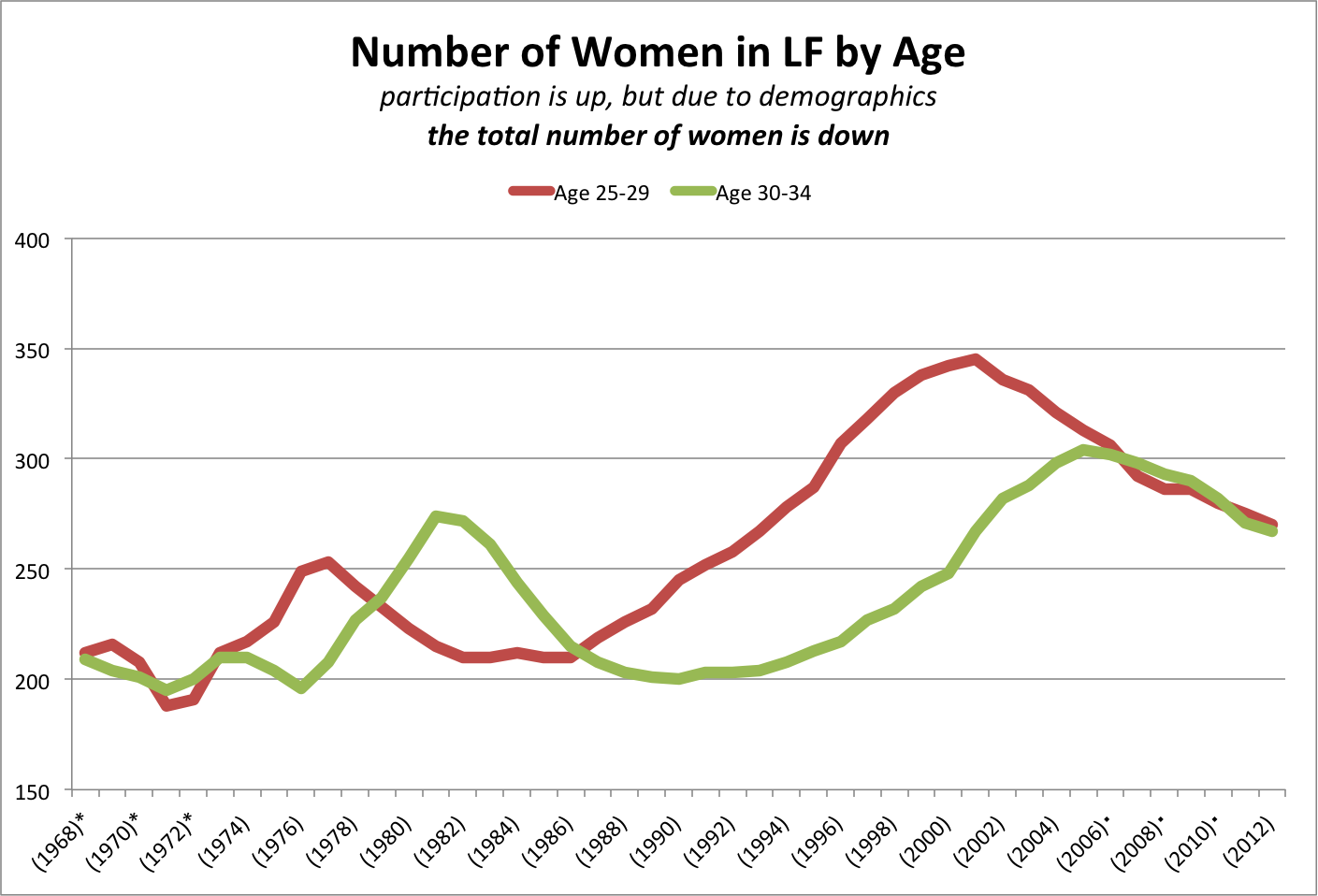
ImageA concurrent set of posts on the NBR Japan Forum is on the role of women in the labor force. At younger ages, the shift towards greater participation is dramatic, a 30 percentage point jump among 25-29 year olds. Participation for women age 30-34 is following in parallel, with about a 13 year lag:
ImageHowever, this is less economically meaningful than at first glance. Women are not going to be able to save Japan from its demographic challenges. Of course it is these very same women who are not having lots of children. But more to the point, these young women are now the only daughters of an already smaller generation of women.
So even a continued increase in women pursuing careers — already apparent among younger women — will only have a modest impact on the shrinking of the labor force. There are simply too few in these age brackets, and the number is falling yearly. Hence despite the rise in participation, the total number continues to decline:
Policy changes could smooth things, and from a microeconomic perspective (and a lifestyle perspective) could bring many benefits, particularly to women. [For an amusing portrayal of the challenge of a stay-at-home father, albeit in a US context, see Kim Stanley Robinson's Forty Signs of Rain.] But from a macroeconomic perspective it's too late for less male-centered policies around the workplace and the home to make a difference.

For the Japanese auto industry – by which I mean the industry located in Japan – this has strong implications. First, this is one of the underlying changes reflected in a set of graphs I posted on the future of the auto industry in Japan: firms hoping to sell cars face a shrinking market. It also means that recruiting workers will be harder. In Japan (unlike in China and India) families do not engage in sex selection (aborting girls), and the change in the number of young men in the labor force is likewise declining. (Indeed, because the participation rate for men has long been near 100%, the drop is more rapid as there has been no offsetting rise in the proportion of men working.)

This shows up too in technical fields; the number of engineers is down 15% from peak and casual observation (academic 2006-7 at Chiba University, a strong engineering school) is that many of those in technical fields are international students. Unless the auto industry (by which I mean suppliers, who generate two-thirds of employment) globalize, they will cease to be players, lacking the engineering clout to stay in the game. And if the unsuccessful efforts of my son (as a TEFL-certified teacher) to find an English teaching job in Japan are at all representative, young Japanese are not learning English. Meanwhile, of course, Honda and Toyota already employ 1,000 or more at their technical centers in the US. As businesses, they are positioning themselves to draw upon a global pool of engineering talent. That however does not help the Japanese industry.

Thứ Sáu, 23 tháng 8, 2013

World Cars, World Trade

GM is positioning Buick as a global brand drawing upon global product. As we've earlier blogged, this will work only if there is a convergence in tastes across major markets that allows the same vehicle to be made and sold with only minor modifications. Now the brand name may not be the same; what is a Buick in China may be an Opel Mokka in Europe and not sold in the US at all – though in this case the Buick Enclave is, as detailed in this Bloomberg article.

homologation and lower tariffs would benefit us

This isn't just to lessen risk (though in the case of China, that's been upside risk!), as argued in Spreading out for a little elbow room, a post by one of my students. Partly it's a story of platforms, as a manufacturer enjoys economies of scale when the same underlying vehicle can be tweaked. But ideally it's about selling the exact same vehicle on a global basis. That then works to the benefit of global suppliers (and to the detriment of medium-sized suppliers in Japan and elsewhere that have a narrow geographic footprint), as an OEM can ask them to supply the same part everywhere, down to the plastics and steel and so on that if allowed to vary can introduce defects, defects that are thus subtle and hard to diagnose, or add on to costs for local redesign and retesting.

At present, however, there are limits. The Insurance Institute for Highway Safety imposes crash tests that are unique to the US. Europe has its rules for pedestrian impact. Headlight standards vary, and require redesign and recertification. A standard approach in Europe – lights that track as you turn, and adjust vertically ascending and descending hills, are not always allowed in other markets. And providing those functions interacts with styling. So homologation of such rules across markets can bring big benefits.

So watch for what happens in the newly launched trade talks between the US and the EU, the Transatlantic Trade and Investment Partnership, as well as the on-going Trans Pacific Partnership talks with Japan, Australia and others. How autos are treated could be a boon to the US industry.

And by the US industry I don't mean just the Detroit Three (though if we're precise, only GM is headquartered in Detroit, reflecting a long-run trend to exit the city). Michigan is the leader of exports within NAFTA, both to Canada and to Mexico. BMW in Spartanburg, SC leads the auto industry in exports, and has just completed a $900 million expansion. (I've been through their paint shop, which includes a PACE Award-winning innovation from PPG that eliminates an entire oven.) But Audi is opting for Mexico because as an exporter they find it a better location for the range of available free trade agreements and resultant lower tariffs. (Audi's plant will be the only one to make certain products, as discussed in The Tariff Advantage of Mexico.)

So homologation and lower tariffs would benefit us, and benefit others. We'd presumably have to lower the temporary 1963 "Chicken War" tariff on light trucks that's still in place 50 years later. But while there is convergence across markets in what people drive and in styling – as our students heard in the spring from J Mays, Ford's Chief Creative Office, reflected in their notes here and here – that convergence is not complete. Japan's "minicar" market is deeply entrenched; so are big pickups in the US. So it's really not credible threat to the Detroit Three, who hold a lock-grip on pickups (Toyota has about a 6% share, Nissan closer to 1%). There's nowhere imports could come from. So as I see it, we'd benefit from these agreements. We might see some low-volume vehicles that for now are found only in Europe, because of the cost of adapting to US standards. Low-volume however is the crucial adjective.

Thứ Ba, 20 tháng 8, 2013

Tesla says Model S crash test score is best NHTSA has ever recorded

by Jonathan Ramsey of AutoBlog

"We found out a couple of weeks ago that the Tesla Model S aced the crash tests administered by the National Highway Traffic Safety Administration. What we didn't know until Tesla filled in some of the details is that the Model S scored more than five stars on the way to recording the best result of any car the NHTSA has ever tested. While NHTSA's highest public rating is five stars, the Vehicle Safety Number it gives to manufacturers can go higher, and Tesla says the Model S scored a 5.4. That's a better result than has ever been achieved in NHTSA testing of a passenger car, SUV or minivan.

Tesla's press release says that after its internal tests showed that it would score five stars on government's crash tests, it addressed any other weak points it found on the vehicle to ensure it would get perfect marks "no matter how the test equipment was configured." It was already going to do well in the frontal test, as the lack of an engine allows much more leeway in creating an occupant-saving crumple zone. And the rollover test was aided by the battery pack being located in the floor. The low center of gravity meant that the Model S couldn't be rolled over "via the normal methods and special means were needed to induce the car to roll."

Nested aluminum extrusions along the hatchback's flanks took care of the side pole intrusion test, the Model S not only scoring five stars but, according to Tesla, leaving nearly nine times more "driver residual space" post-impact than the five-star rated Volvo S60. And when the roof of the Model S was tested for crush resistance, the testing machine broke just after it crossed the four-G mark - the Model S, on the other hand, didn't."

Ruggles writes: A neighbor bought one of these. It is flat out beautiful. I have seen them at auto shows and at a Tesla showroom, but this is the first one I've seen on the road. My wife made me go around the block for another look, and she is ambivalent about cars.

I predict the beef over the Tesla company owned showrooms will blow over. Even Elon Musk isn't rich enough to finance a real distribution system, even if he included all of his friends. As long as they are a boutique manufacturer, he'll be just fine with the current setup, as we noted in a May 23rd post on Tesla's Distribution Challenge. The next step, if he gets that far, will require a dealership system. He will be selling off his company owned stores for large multiples. It isn't practical to try to attract investors if they know they would be having to compete against their supplier. Then there are those pesky franchise laws.

Super investor increases stake in General Motors

As feds are selling GM stock, Buffett is buying.

DealersEdge Headlines

Billionaire Warren Buffett's investment firm Berkshire Hathaway Inc. boosted its holdings in General Motors by 60 percent to 40 million shares, the firm disclosed in a recent SEC filing. That brings Berkshire Hathaway’s holdings to 2.9 percent of outstanding GM stock, according to a report in the Detroit News and SEC filings.

The firm initially purchased 10 million shares in 2012, when the stock was trading in the low $20-per-share price. It closed last week at $34.55, down $1.02. At current prices, the stake is worth more than $1.38 billion.

Mr. Buffett acquired the new shares in GM in the three months ending June 30. That's the same period during which the U.S. Treasury has been steadily selling off its holdings in GM it received as part of its $49.5 billion bailout.

Thứ Bảy, 17 tháng 8, 2013

British Auto Legends stamp campaign

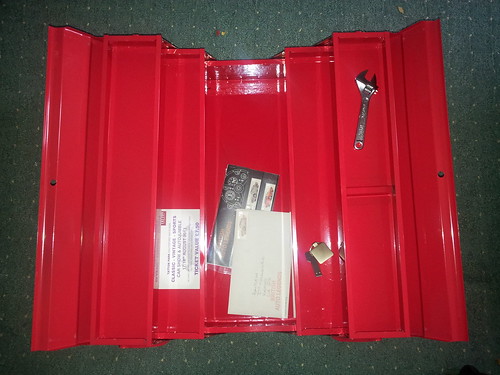
Check out what the postman dropped off yesterday: It's a bright red Royal Mail tool box, personally engraved with my name.

I am delighted to be invited to take part in the Royal Mail British Auto Legends stamp campaign - celebrating 10 of the most famous British classic marques:

Untitled

Untitled


Untitled

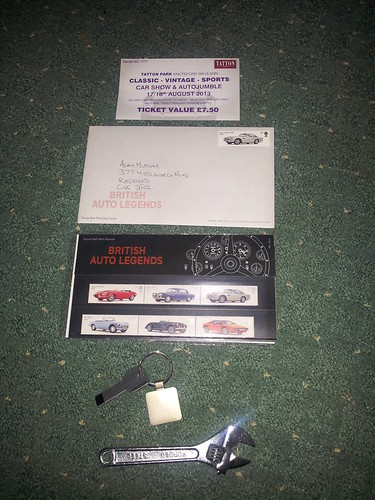
Inside was a first day cover with letter, the new British Auto Legends stamp collection, a USB stick shaped like a key and containing all the information about the collection including the cars, a ticket for the Cheshire classic, vintage and sportscar show on thew 17-18 of August (which I was unable to attend) and finally, a small stainless steel forged spanner.

Untitled

The Thoroughbreds
  1. Jaguar E-Type
  2. Rolls-Royce Silver Shadow
  3. Aston Martin DB5
  4. MG MGB
  5. Morgan Plus 8
  6. Lotus Esprit
The Workhorses
  1. Morris Minor Van
  2. Austin FX4
  3. Fords Anglie 105E
  4. Land Rover Defender T10
The workhorses received a bit of flak from the Top Gear team, especially the Ford Anglia 105E, which was the favourite of the British police in the 1960s.


My favourite has to be the Aston Martin DB5, which became famous after appearing in the 1964 James Bond film Goldfinger. This car was launched in 1963 and had a 4-litre (3995cc) engine with 242bhp (5500rpm) and a top speed of 144mph (232kph).

Which one is your favourite classic car?

Visit their facebook page www.ifyouhadtopickone.com for a chance to win one of these great cars for a weekend.

2014 BMW M4 Concept

The BMW Concept M4 Coupe was unveiled at the “Concours d’Elegance” in Pebble Beach on the 16th of this month. A peek into their vision of the future sports car.


Thứ Năm, 15 tháng 8, 2013

Fuel Cells Still a Viable Option?

Based on an original post by Daniel Tomm on the Econ 244 course blog

By chance there is a CNN Money story today (Aug 15) on fuel cells, Has the fuel cell car's time finally come?by Brian Dumaine, senior editor-at-large @FortuneMagazine, which will appear in the September 2, 2013 issue of Fortune. This post was written prior to seeing that story.

Automotive News reported here on May 13th that Hyundai, Mercedes, Nissan, and Toyota have been working with the U.S. Department of Energy to prepare hydrogen fuel-cell powered cars. This public-private partnership – if successful – will lead to a new class of alternative fuel vehicles. These would cut point-source emissions to zero, because the only on-vehicle byproduct is water. At present the underlying hydrogen source is natural gas; fuel cells thus likely have a low overall greenhouse gas emissions burden.

...specialized applications may develop ... passenger cars won't be one of them...


As of now only the Honda FCX Clarity and the Mercedes-Benz B-Class F-cell are used in certain U.S. markets as test vehicles. With the help of the DOE there are hopes of increasing the number of car options using fuel cells. One problem is that there are not many fueling stations, making them impractical for most vehicle users. New partnerships may help shift this chicken and egg dilemma, as Nissan, Mercedes-Benz and Ford unveiled a joint venture with the intent of bringing fuel cell vehicles to market by 2017.

The Prof drove an experimental Ford fuel cell vehicle a decade or so ago. The fueling barrier noted above seems no lower than before. Hydrogen, however, is widely used in industry so given demand, stations could be set up, as we're seeing with natural gas and with fast electric vehicle recharging stations. Critical issues remain. The fuel cell membrane uses platinum as a catalyst and is hard to manufacture, on-vehicle storage is both expensive and requires large tanks that eat up space, and the fuel cell system doesn't like cold weather. I'm very skeptical that fuel cells will ever be viable – particularly as the alternatives keep improving so that the competitive hurdles are getting higher, not lower. Reflecting that, Dr. Chu as Secretary of Energy did not push hard for fuel cell research.

If there's been a breakthrough to change such commercial calculations – as opposed to political calculations coming from Congress – I've not heard of them. Media coverage [August 14, 2012 on Daily Tech and a Feb 4, 2013 note on Fuel Cell Today] of the modest continuation of research pointedly avoided details of fuel cells themselves, and instead noted the improved potential low-cost availability of hydrogen thanks to natural gas discoveries. The Department of Energy Fuel Cell Vehicle web site says nothing to the contrary, and FuelCell.org contains the normal news of incremental improvements – and of non-passenger car uses. Fuel cells will continue to get better. But to reiterate, so will the alternatives – and those alternatives are already far superior. While specialized applications may develop, my continued belief is that passenger cars won't be one of them.

Thứ Ba, 13 tháng 8, 2013

Commedian Tim Allen featured in new episode of GQ’s Car Collectors

In this episode of GQ’s Car Collectors, Tim Allen shows off his collection including a Volkswagen Beetle with a 200-hp engine and his Studebaker Sleeper Cab that doubles as a campground for his four-year-old daughter.

He starts off with a very long "ahhhhhhhhhhhhh"


The Tariff Advantage of Mexico

Adapted from a post by Griffin Cook on the Econ 244 blog, May 18, 2013

Audi's decision to place the plant that will build the new Q5 crossover in Mexico resulted from more than cheaper labor and government incentives. After all, assembly is likely 10% or less of manufacturing costs, and direct labor only one piece of that. Inventives are even less a factor – what big greenfield plant wouldn't likewise enjoy incentives if located in the US? (See an August 13th Bloomberg story on efforts to recruit car-related factories in the US.) So other considerations likely dominate.

According to CEO Rupert Stadler, Europe's growing interest in SUVs and and crossovers played a key role. The European Union slaps a 10 percent tariff on U.S.-built vehicles, which would have cost Audi more than $3,000 per vehicle – and only 25% of the plant's cars will likely be sold inside NAFTA. A majority will instead be headed for the European Union.

This is part of a growing trend in which cars are produced in a foreign country and then exported to the home country, in part due to cheaper labor costs and flexibility in trade laws, but also access to a supply base and to hedge foreign exchange risk. This presents a problem for the European Union, with production in its periphery, outside the Euro zone.

So watch for what happens in the newly launched trade talks between the US and the EU, the Transatlantic Trade and Investment Partnership. Lowered tariffs would help the US. And another component is homologation, which might lessen the divergence in safety and testing standards that mean that Audi and BMW (whose South Carolina plant exports 70% of its output) must produce slightly different products for different markets – variations in headlight standards, how emissions are measured, and on and on.

Sources:

Thứ Hai, 12 tháng 8, 2013

Panasonic goes global with QNX CAR platform

Paul Leroux
In the automotive market — or any market, for that matter — a product platform must be judged by its flexibility. After all, the whole point of a platform is to help you create multiple products or product lines, each with its own distinguishing features, while reusing as many components as possible. Done right, a platform lets you target multiple price points, multiple consumer segments, and multiple geographies, in the least time and at the least cost. If that doesn’t define flexibility, I don’t know what does.

Which brings me to Panasonic Automotive Systems Company of America. They’re an international supplier of infotainment systems — Chevy MyLink and Chrysler Uconnect are just two of their products — and they need this kind of flexibility to deliver localized solutions  to their OEM customers in North America, Europe, and Japan. To help achieve it, they use the QNX CAR platform.

Flexible by design: MyLink supports
a touchscreen, voice commands,
and steering-wheel buttons.
To quote Scott Kirchner, vice president and CTO of Panasonic Automotive Systems, “we wanted a platform that would let us quickly customize our infotainment systems for a variety of markets and customer requirements — the QNX CAR platform, with its modular architecture and support for mobile connectivity standards, provides the inherent flexibility we were looking for.”

That quote comes from a press release issued just a few minutes ago. To read the release in its entirety, visit the QNX website. But before you click, remember also to visit the Chevy website, where you can find out more about the MyLink system. And did I mention? MyLink has been building quite the trophy case, what with the Best of CES 2013 Award it won in January and the CTIA Emerging Technology (E-Tech) Award it won in May.


Chevy MyLink system.
Images: Chevrolet

Fasten your seat belt [Video]

Really beautiful video titled 'Embrace Life'. The message gets through without a single word being spoken and not a car in sight.

Chủ Nhật, 11 tháng 8, 2013

Red and Yellow

A guest post by Andrew Shipp; original draft May 15, 2013 on the Econ 244 blog

Florida revealed a scheme to shorten yellow light times. The reduced intervals have, in some areas, doubled the tickets given to citizens for running a red light. According to one Dept of Transportation official, the practice may raise money for the state but makes traffic extremely unsafe. "A one-second increase in yellow time results in a 40 percent decrease in severe red-light related crashes." In some communities the yellow light interval change was below the nationally mandated minimum time limit. After that was discovered, the counties upped the time back to national levels but did not tell the drivers who were ticketed under the old light time.

(WTSP 10 News followed the story.)
The Prof notes that in some countries traffic signals include time remaining,
and drivers are off the moment a light turns green. Woe to anyone who fails
to stop in advance of a light turning red!

Thứ Bảy, 10 tháng 8, 2013

The Decline of the Japanese Auto Industry

Here are three graphs, pulled from a talk I gave at UMTRI in the spring. The Japanese auto industry – that is, manufacturing and retail inside Japan – faces permanent decline.

Two trends interact. First, due to demographics Japan's population is in decline, and so is the number of licensed drivers. I don't have statistics on the latter, but I have used Census data and population projections to calculate the potential number of licensed drivers. (In Japan you can't get a license as young as in the US, and after age 70 it becomes increasingly hard to get your license renewed.)

Second, the vehicle mix is unfavorable. From the production standpoint, exports are important, but the data show that the market isn't increasing, has more low-value vehicles and is very volatile. The third graph is the domestic parc, which is what matters for dealers. Here the story is even worse, while full-sized cars rose in share along with incomes, that process has ended. Instead what we see is a decline in mid-size car sales (compacts in the US context) and their replacement by "kei" minicars.

Here are implications, as I see them.

  1. Over time dealers will face extraordinary pressure. That will be accentuated by the geographic aspect of population decline, because population will fall more and age faster in rural areas where car ownership is highest. Rural areas are already distinctly older than the major urban areas (Tokyo-Yokohama-Kawasaki-Chiba, Osaka-Kyoto-Kobe, Nagoya, Hiroshima, Fukuoka-Kita Kyushu, and Sapporo). Their potential market is literally dying off. Dealerships in Japan are also unable to sell across prefectural boundaries, so better-run dealerships can't use the internet to extend their geographic market to offset local decline.
  2. Manufacturers will face a smaller market. They have a large number of distribution channels – not including trucks, Toyota has six channels: Daihatsu, Netz, Corolla, Toyopet, Toyota and Lexus, with lineups that overlap and cannibalize each other. (Dealerships are also multi-point, with sales points each trying to buy business from other parts of the same dealership, while the strong players in used cars are independents such as Gulliver.) Rationalizing production and model mix and distribution will be traumatic, as we've seen with the efforts of GM, Ford and Chrysler in dropping multiple brands.
  3. Suppliers will have an even harder time. Small Japanese suppliers were slow to internationalize. Even worse, when I've visited suppliers in Japan for engineering presentations – and in sharp contrast to similar visits in the US and France – I've been the only non-Japanese in the room. That hurts in two ways.
    • First, there just aren't that many would-be engineers graduating from Japanese universities. Without international staff they simply won't be able to stay in the game. Honda and Toyota have huge engineering operations in the US that can handle the entire vehicle development process. As far as I can tell, that's not the case with most Japanese-headquartered suppliers.
    • Second, in order to serve their customers on a global basis, suppliers need to have the same global capability. Some will finesse that by being acquired by foreign firms, and thereby globalize their engineering. Others will prove unable to build a global engineering and manufacturing presence because they've been slow to delegate decision-making and build capabilities and staffing outside Japan. They will steadily lose market share to firms with HQs outside Japan. Indeed, my scanning of industry news (in English, Japanese and [less frequently] German) supports that. Toyota is turning more and more to the big US/Europe based global suppliers, because their own "keiretsu" suppliers can't support Toyota's global footprint.
    • Now this is a third bullet, but is speculative so I won't claim it as a 3rd point. My belief is that because of the two factors above Japanese suppliers lag in technology. Casual empiricism turns to the body of finalists in the Automotive News PACE competition, who are chosen on the basis of successful innovation. Japanese firms are largely absent. [Mea culpa: the competition is entering its 20th year, and I've been a judge since the start.] Not having a truly global mindset, not having the bulk of engineers in Japan able to use English as a working language, means that Japanese suppliers are behind the eight ball in technology. Sometimes it's better to be a bit behind where you can learn from other's mistakes and simply not invest spend money on "advanced concept" R&D that leads to dead ends, the "bleading edge" thing. OEMs also want second sources, so even firms that have reasonable intellectual property know they won't have a monopoly. Still, my judgement is that being second source is less profitable. And being second-source based on production in Japan is a losing proposition.
  4. Japan, as a geographic entity, is already a shrinking part of the global industry. Of course the growth of the BRICs and ASEAN means the same is true of the Euro zone and of NAFTA. My belief is that slow internationalization will accentuate the impact of a shrinking domestic market. That's particularly good new for non-"Japan" suppliers.

In the 1980s the US industry feared that domestic firms would disappear under the onslaught of Japanese "keiretsu" suppliers. That's not what we see if we look at the top 100 suppliers today.

Thứ Năm, 8 tháng 8, 2013

From Hollerith to HTML5: the inevitable rise of the programmable car

Paul Leroux
Some people are crazy good at predicting the future. Case in point: Nicola Tesla. In 1909 he proclaimed that "everyone in the world" would one day communicate with wireless handheld devices. At the time, people must have thought he was, well, crazy. But look around you: when's the last time you weren't surrounded by people using wireless handhelds?

Over the years, the auto industry has produced many technology visionaries who share this talent for prognostication. Mind you, visionary is probably the wrong word. Many of these people didn’t simply envision the future; they tried to build it. All too often, however, the technology needed to make their ideas work was still in its infancy — or simply didn't exist yet.

For evidence, consider the ITER AVTO. Introduced in 1930, this dash-mounted navigation system used maps printed on rolls of paper. These maps were connected by a cable to the speedometer and would scroll forward in proportion to the car’s speed. It was all pretty cool, provided you didn’t make a turn — otherwise, quick, change rolls! Basically, a great idea hampered by the tech of its time:


Source: Dieselpunks

For another example, consider these “alarming” glasses, which made their debut at the Frankfurt Motor Show in 1951. The concept was simple: monitor eye movements to determine whether the driver is falling asleep; if so, sound an alarm. Just one problem: to detect eye movement, the glasses used a thin steel wire pressed against the driver’s eyelids. It was another great idea that needed yet-to-be invented technology — in this case, inexpensive (and non-invasive) eye-tracking cameras — to work.


Source: Modern Mechanix blog

And then there’s the 1969 Buick Century Cruiser, an autonomous concept car that used punch cards to program the car’s destination. The driver would insert a card encoded with a destination, and an electronic highway center (whatever that was) would then take over and guide the car to where it was programmed to go.


Source: Car Styling 2.0 

The car was never intended to be sold, of course. To be commercially viable, it would have required technologies that simply weren't available in 1969.

But you know what? I think the Century Cruiser represents a watershed concept: that you can use software to control or enhance a car's behavior. The Century Cruiser may have used Hollerith cards, but it presaged vehicles that, in a few short years, would use programming languages like C to control ECUs and anti-lock brakes. From there, it was only a matter of time before cars would use software technologies like HTML5 to deliver everything from weather reports to smartphone integration. The software path was set, even if no one realized it yet.

Thứ Ba, 6 tháng 8, 2013

Controlled openness

Paul Leroux
The title of this post sounds like a contradiction in terms. But you know what? It captures the predicament faced by every automaker today.

On the one hand, automakers need to convince mobile developers that it's worthwhile to create apps for the car. They also need to make the process of creating and monetizing car apps as easy and open as possible. Otherwise, why would a developer spend time developing a car app when a phone app could reach many more customers? (About 60 million cars shipped in 2012, compared to more than 545 million smartphones — and most of those cars can't host apps.)

On the other hand, apps can't run willy-nilly in the car. For safety's sake, automakers must impose control on when specific apps can be used, and the apps themselves must be designed or modified to minimize distraction, possibly in accordance with government-mandated rules and guidelines. That may sound like an imposition on developers, but not really. After all, developers want to create apps that will prove popular with consumers, and consumers will be far more interested in apps that can be used while the car is moving — apps that, for safety reasons, can be used only when the car is stopped will hold less appeal.

But enough from me. Recently, my colleague Andy Gryc caught up with Thilo Koslowski, VP Distinguished Analyst at Gartner, and they discussed the notion of controlled openness for the car — along with how HTML5 fits into the picture. The cameras were rolling, so grab some popcorn, dim the lights, and check it out:


Chủ Nhật, 4 tháng 8, 2013

Diversion: An Economic Model of US Elections

Economics helps explain disarray in politics, at least politics US-style. Put every voter on a line, from right to left; candidates move towards the center. With a little bit of detail added, this model, due to Hotelling, helps clarify the strategic nature of our electoral game. (Harold Hotelling's simple model of product differentiation dates to 1929. The politics version is the median voter theory.)

Where on a small beach would two pushcart vendors locate? Assume they start on the ends of the beach, each to their own side. They then split the business – everyone goes to the nearest vendor, with the person in the very middle indifferent which he chooses. But let one vendor push his cart partway towards the center, and that cart then splits the business that lies between, plus everything towards their end, and so gets more than half the business. The response is obvious: the other cart moves towards the center as well. Repeat, and eventually they're next to each other, at the center of the beach.

So let's look at an election to Congress. That process starts with primaries; there's lots of local variation, but for simplicity assume they're limited to party members. Now voting is inconvenient, and primaries don't always get much publicity. So let's further assume that only those who really care vote. Candidates align themselves at the center of their party, and so we get one candidate at the 1/4 mark, another at the 3/4 mark. He who can move most successfully to the center wins the popular vote. If one candidate missteps and does not quite move to the center, the other candidate can take advantage of that. Of course random factors matter – an untimely scandal, spending money unwisely, misjudging which states are on the edge and so not allocating enough time, or even personality. The model doesn't capture everything.

This simple model highlights the dilemma Republicans (and in some races, Democrats) face, as the primary system pulls them to the right, with the issue of race (plus, less centrally, social nostrums) uniting a large enough block of activists to turn out to vote. As activists moved further from the center, that suggested that Democrats could win presidential elections even with weak candidates, by moving to right of center. Put in a strong candidate, a good campaigner such as a Clinton or an Obama, and you have a landslide. (Strong candidates and strong presidents aren't the same thing – we elect people because they're good at campaigning, not at policy or administration or negotiating with Congress.) Party activists who love the game, or love power are happy with this process. However, the party faithful will typically be unhappy with their final candidate, because the median activist isn't a centrist.

Now lots of assumptions are hidden in this model. However, we don't need a perfectly uniform distribution, or (with lots of caveats) only one dimension. We can, for example, let money sway matters, allowing candidates to "buy" votes. Of course two can play that game, and if it's harder to buy votes the further you are from a potential voter's position, then there's still pressure to move towards the other candidate.

However, the model does require flexibility; voters opt for whomever is closest to them, even if they're at one end of the spectrum and the candidate is all the way in the center. In other words, no one running for office gets locked into their initial positions. (In economics, the Stackelberg model assumes that's not the case.) A second crucial assumption is that there are only two players; three's a crowd, and there's no equilibrium strategy. Third, if the market is a circle rather than a line, then two players move as far apart as they can, the opposite result – but in my judgment that's not how politics works, even if the extreme right and the extreme left may be hard to distinguish on strong state issues (think Weimar Germany, where both the right and the left were nascent dictators and central planners).

So why are our politics not centrist? First, there seems to be a limit on how quickly (that is, how far) a candidate can re-center after the primary. In terms of the Hotelling model, if voters are limited in how far they will travel – they won't vote for someone who "betrays" them – then candidates will be limited in how far they can reposition themselves after the primary election. (In the Hotelling model, this comes for example from using the square of the distance a voter must travel.) The harder it is for a Republican to shift away from positions needed to win a primary, the easier it is for the Democrats. But potentially the Democrats enter the race with similarly untenable positions, if their primaries are similarly dominated by activists far from the political center. Casual empiricism, though, suggests that while there is a distinct "Right" in American politics, there is no Left – the US has never had a strong Socialist Party, or even a Labor Party. What "liberal" means is unclear. And that's an important point. Due to their diffuse positions those with some sort of liberal inclination have only a weak pull on a candidate, and a good grassroots campaign can turn out their vote.

In the last election, Republican candidates did not move. Perhaps this was a defect in the candidates themselves, or in their use of the same political advisors they employed in the primary, who were unable to distance themselves from their "natural" constituency. However, it's not just been this one election, and the Democrats (rhetoric aside) seem to be center or center-right, which would be consistent with what would happen with a coherent Right and an incoherent Left. To reiterate, the Greens and others on the left have always been too fractured to be a threat in primary elections. And when they do field a candidate who has campaign salience, the result is electoral disaster for Democrats: the further a candidate moves towards the Republicans, the greater the potential for a magnetic personality such as a Ralph Nader to nibble away at the more liberal part of their base.

Of course if being an incumbent get's you close to half the vote, then strategy doesn't much matter – an incumbent has to try hard to lose. Redistricting throws open the process, at least on the margins; scandals can matter. (Think of this as adding a second dimension, a "probity" axis, where scandal means the incumbent has chosen an extreme position, on the sideline, thereby ceding more of the playing field to the opposition…) In addition, for the House (but not the Senate) local issues can have salience. In practice, though, that seems to mean that rural candidates are always pro-farmer, whatever their party label; candidates move so far to the center that they're indistinguishable on such local issues. In any case, to the extent that incumbency dominates other factors, the only elections where this Hotelling model matters are ones for open seats – whether one views Romney's candidacy as amusing or as sad, if incumbency really matters, it was doomed all along to irrelevance.

To sum up, the Hotelling model suggests that a large swath of voters will always be unhappy with presidential candidates, come the general election. Our politicians are "slick" and "untrustworthy," flip-flopping, betraying those who worked for them in the primaries. Thanks to smaller electoral districts and hence a less diverse electorate – gerrymandering accentuates that – members of the House will also be more polar than the electorate as a whole. Granted, you always want to bargain down to the wire. But if the center dominates, then you do end up with a deal. That doesn't seem to be happening today, and this simple economic model suggests that all that is required to generate this is the rise of a modest-sized "sticky" right.

Addendum: Economics insists that models aren't sensible if they don't lead to equilibrium behavior. A "sticky" right opens room on the left for a third-party candidate, because it leads Democrats to move to the right of center. If political entrepreneurs succeed in finding issues that will unify those to the left, then the center can lose all salience. Now the right end of the US spectrum seems to have defined itself around racial and class lines, white and prosperous, with a largely overlapping group of social conservatives. That's a shrinking base, but the Hotelling model suggests that as long as we maintain a system of party-oriented primaries, that base won't become irrelevant anytime soon, at least for the House of Representatives. This is not what many political pundits assume to be the case, but does match the continued power of a distinct minority in the House. We'll see come fall whether the Senate continues to be less affected.

One other implication is that in districts with strong incumbents, it's hard to motivate the average person who might vote for an opposition candidate. Only strongly driven voters participate – in other words, you get kooky candidates, who take positions incompatible with any sort of move to the center. That reinforces the strength of the incumbent...

Thứ Bảy, 3 tháng 8, 2013

GM, and Ford – Onward and Upward?


As of this writing, the stock price of General Motors closed at almost $37.00, while Ford closed at about $17.  Both announced strong second quarter profit results.  Have GM and Ford peaked?

I’m not in the business of giving buy/sell stock recommendations but a discussion of both the head winds and tail winds the Detroit 2 automakers face going forward might be interesting.  

In the case of GM, the current stock price represents a degree of redemption.  GM’s Initial Public Offering stock was priced at $33.00 in November 2010, after it emerged from Chapter 11 bankruptcy. Immediately after the IPO the stock price took a quick jump to near $40.00, then dove to a low point of around $18.00 as recently as 18 months ago.  Some RW pundits, including Forbes, were predicting GM would be back on bended knee to the U.S. Government looking for funds to survive.   Since the IPO, GM has hemorrhaging cash in Europe as was the old GM.  

But after a decent first quarter in2013, GM just announced a $1.2 billion profit for the second quarter.  The company holds over $44 billion dollars in cash and credit and is rolling out new and well accepted models every few weeks, it seems.  The company enjoys a favorable UAW contract for the next few years, and is selling into a U.S. auto market with considerable pent up demand.  Chevrolet is setting sales records, and a resurgent Cadillac has restored brand prestige.  In fact, production restraints from cutbacks made during the bankruptcy period restrain current production and profits. 
It is expected that the U.S. Government will complete its sell off of GM stock in 2014.  In the middle of all of this, GM and its stockholders enjoy a gift provided by the Federal Government.  The new GM was granted “loss carry forwards” from the old GM that could amount to $45 billion in tax savings in the coming years.  That’s a lot of money that can be deployed in new technology and model development.  

On the flip side, GM’s market share remains a challenge.  Toyota has regained the mantle of world’s largest auto manufacturer.  There are no big captive finance arm profits contributing to overall results as there used to be with the old GM and its captive GMAC before GMAC got involved in mortgage lending.  For perspective, GM Financial, GM’s new “owned captive,” contributed $264 billion to GM’s bottom line. Ford Motor Credit contributed $454 million to Ford’s bottom line on about 20% fewer vehicle sales.  Ally Bank, GM’s “non owned captive,” and the old GMAC, is using its own profits to pay back to U.S. taxpayers for keeping it alive during the 2008 – 2010 crisis. 
Europe remains a challenge for GM.  Vice Chairman Steve Girsky has been been dispatched there to deal with the morass of labor and bureaucratic issues in a market that doesn’t look like it will rebound any time soon.  But the losses in Europe have recently been trimmed.

There continues to be executive shuffling at GM.  There are a couple of major exec announcements a month with high level executives either being “broomed” or leaving for “personal reasons.” The Board of Directors has developed no plan for CEO Dan Ackerson’s successor and seems to be particularly dysfunctional.  Ackerson himself seems to be a challenge for GM employee morale.  Even the rapid growth in China has been tempered recently.  GM’s recent buy into Peugeot is interesting.  Noted auto industry analyst Maryann Keller referred to that recent investment as “GM buying in to a “black hole.” 
 
Ford’s stock had reached low ebb in November 2008, closing as low as $1.26.  The stock price peaked at $19.00 in January 2011, driven by Cash for Clunkers euphoria and auto industry exuberance caused by the record GM IPO. The current stock price represents a significant recovery from $9.20 in November 2011.  The company just announced a second quarter pre-tax profit of $2.6 billion, which is more than GM on fewer sales.  The company states their liquidity as $37.1 billion.  Ford recently doubled its dividend to 10 cents per share, its highest in seven years.  according to Reuters. 
Ford also benefits from the same beneficial UAW contract it gained from UAW as a consequence of the overall U.S. auto industry reorganization. Ford Motor Credit contributes greatly to the parent company’s bottom line.

Ford, like GM, is challenged in Europe and is facing market share erosion at home.    Ford has to compete with two U.S. competitors, Chrysler and GM, which shed debt through their bankruptcies, while having to pay all of its own obligations.  The company continues to struggle with the Lincoln brand, having shed its Mercury division.  

On balance, things look good overall going forward for both automakers, despite the obvious challenges.  Europe won’t be in the economic doldrums forever.  Despite declining market share in the U.S., the home market seems to be advancing toward the old standard of a 17 million SAAR. (Seasonally Averaged Annual Rate)  As costs stay in line and sales continue to advance with the expanding SAAR, without huge incentives required to achieve them, profitability should stay strong for the both automakers for the foreseeable future.  Some analysts see Ford as a $40.00 stock with GM at $60.00.  Time will tell.