Automotive News is the leading source of news about the global automotive industry. ... tirelessly to force the auto industry and federal and state regulators to make cars, SUVs, pickups and minivans safer. ....
Thứ Ba, 29 tháng 7, 2014
QNX-powered 2015 Audi TT named best-connected car
It seems I’m not the only one who's impressed. Because last week, 42,500 readers of “auto motor und sport” and “CHIP” chose the Audi TT as the industry's best-connected car. In fact, Audi took top honors in several categories, including navigation, telephone integration, sound system, entertainment/multimedia, and connected car.
To get an idea of what all the fuss is about, check out our video of the Audi TT’s virtual cockpit in action. We filmed this at CES earlier this year:
For more information on the award and the Audi TT, read Audi's press release.
Thứ Bảy, 26 tháng 7, 2014
Mitsubishi Motors Future: Summer Guest Post #1
This post was written May 12, 2014 by Anton Reed '14 for Economics 244. The Prof edited it and appended comments by others in the class.
For my own analysis see Mitsubishi Motors: Going-going ... gone? on this site.

In April, when they released their FY2013 annual results, MMC (Mitsubishi Motors Corp) reported record profits. Don't get too excited.
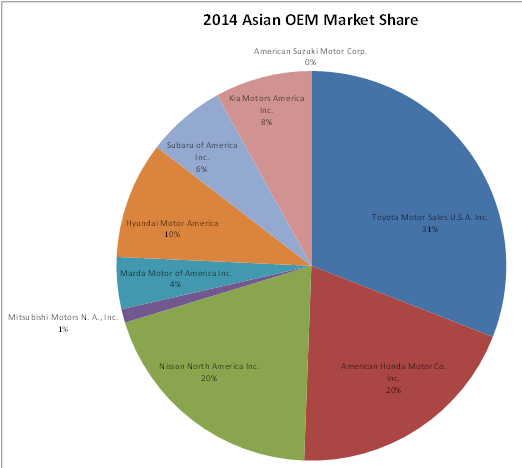
Mitsubishi Motors' North American operations are struggling; MMC sells far less than any other Asian car company in North America. The next smallest, Mazda, sold almost three and a half times as many vehicles in April 2014. Only six firms sold fewer cars, and of those only Volvo is not a niche luxury marque. (The other five, in decline order of sales, are Jaguar/Land-Rover, Porsche, Tesla, Maserati and Ferrari.)
There are positive signs, with April sales up 46.6% over 2013 and year to date sales up 29%. Only Maserati had a larger increase, but they sold 753 vehicles last year, so that shift represents only a few additional cars. On the other hand, among manufacturers building cars for mainstream customers, Mitsubishi sells the least, so its percentage increase likewise represents only a modest absolute change. Nevertheless Mitsubishi has been improving its North American operation, with net sales up 53% from 2012 to 2013.
Such sales however mean that MMC's Illinois plant – begun in 1988 as Diamond-Star during the era when Chrysler was a major shareholder – continues to operate in the red. Whether or not Mitsubishi will be able to mount a comeback from the brink of essentially complete failure in North America will depend heavily on the continued expansion of their share and the overall vehicle market. Summer sales are expected to be substantial enough to grow the car market in 2014 over 2013, but that increase won't be enough to float MMC. Mitsubishi will likely see its sales cannibalized by the other automakers and go the way Suzuki, Isuzu and Daihatsu, Japanese firms that have completely withdrawn from North America.
Sources: www.motorintelligence.com and www.mitsubishicars.com. Sales graph on right added by the Prof.
STUDENT COMMENTS / DiSCUSSION
Louis Ike · I do not see Mitsubishi making much of a resurgence in sales here in North America. The number of dealerships around any one geographic location is much lower than its competitors, and this only mimics the pattern of low sales volume. The cars that Mitsubishi is currently making, to put it simply, do not fit the consumer preferences of the modern North American. In my opinion, Mitsubishi needs a serious rebranding because its public image is one of cheap, ugly, and obsolete vehicles.
Now however do consumers even know (much less care!) that MMC is a “Japanese” company? Or that the vehicle was made inside NAFTA, or imported from Japan / Korea / Europe? It’s an empirical question, and the surveys I've seen suggest consumers no longer care about national identity and import status, though "Munroney sticker" legislation mandates manufactures provide those details on the window sticker found on all new cars. See my thoughts on MMC here: Mitsubishi Motors: going, going … gone?
Thứ Tư, 23 tháng 7, 2014
Better safe than sorry — don’t miss our webinar on automotive systems
![]() |
| Lynn Gayowski |
Enter my esteemed colleague Yi Zheng. Yi will be presenting a webinar on Designing Automotive Systems with the ISO 26262 Standard. Highlights will include:
- Lessons learned from safety standards in other industries
- The key concepts of ISO 26262
- What ISO 26262 requirements mean for the design of your system
If you’re looking to brush up on your automotive safety knowledge I invite you to join. Here are the details:
- Designing Automotive Systems with the ISO 26262 Standard Monday, July 28, 2014
- 9 a.m. PT / Noon ET / 4 p.m. UTC
- Registration & more info here.
Attend from the comfort of your home or office – no parallel parking required!
Thứ Hai, 21 tháng 7, 2014
The lost concept car photos
At least once a year, the QNX concept team retrofits a new vehicle to demonstrate how our technology can help auto companies push the envelope in connectivity, infotainment, and acoustics. And, in every case, we take pictures — sometimes, lots of them. Inevitably, we end up choosing a few images for publicity purposes and filing the others. But as I discovered, the images we don't use are often just as good as the ones we do use. We just don't need all of them!
In any case, stumbling across these photos was great fun. I thought you might enjoy them, too, so here goes...
The Porsche
First up is the QNX technology concept car based on a Porsche 911, which made its debut at 2012 CES. We had originally planned to drive the car back to Ottawa once CES was over — but that was before we spoke to our friends at Texas Instruments, who provided the silicon for the car's instrument cluster and infotainment system. They liked the car so much, they asked if we could bring it to their HQ in Dallas, where the following two photos were taken. All I can say is, Dallas is home to at least one awesome cool photographer. Because rather than curse the crazy lighting, the photographer used it to create some playful compositions:


If you look below, you'll see another shot of the Porsche, taken just before we shipped it off to CES. The image really doesn't belong in this collection, as it appeared once on a partner website. But it's rare nonetheless, so I decided to include it. And besides, it's cool. Literally.

Did you know? The original Porsche 911, which debuted in the early 60s, was dubbed the 901. Problem was, Peugeot had exclusive rights in France to three-digit car names with a 0 in the middle. And so, the 901 became the 911.
The Bentley
Next up is the QNX technology concept car based on a Bentley Continental GT. In this image, the driver is interacting with the center stack's main control knob, which was mounted directly on a 17" touchscreen. See the row of icons just above the knob? These represented HVAC, music, navigation, hands-free calling and other system functions. The system would automatically display these icons as your hand approached the display; you would then turn the knob to choose the function you wanted. (This image was taken by a BlackBerry employee, whose name I have most ungraciously forgotten.)

As with our all concept vehicles, the intent was to showcase the technology that we had built into the car's dashboard and center stack. Which probably explains why the following image of the car's exterior was never published. Pity, as it's quite lovely — a classic case of flare adding flair.

Did you know? Those wheels aren't just for show. The Bentley comes equipped with a 616 hp W12 engine (yup, three banks of cylinders) that can do 0-60 mph in a little over 4 seconds — it took me way longer than that to type this sentence.
The Jeep
Next up is the Jeep Wrangler, which serves as the QNX reference vehicle. The Jeep plays a different role than the other vehicles highlighted here: instead of demonstrating how QNX technology can help automotive companies innovate, it shows what the QNX CAR Platform for Infotainment can do right out of the box. In this image, you can see the vehicle's main navigation menu:

Did you know? The original infotainment system in the reference vehicle could post Facebook updates that listed the title and artist of the song currently playing. The system performed this magic in response to simple voice commands.
The Vette
The QNX technology concept car based on a Chevrolet Corvette made its debut at SAE Convergence 2010. Among other things, it showed how digital instrument clusters can morph on the fly to provide drivers with context-sensitive information, such as turn-by-turn directions. You can see a slicker, more sophisticated approach to reconfigurable clusters in our most recent technology concept car based on a Mercedes CLA45.

Did you know? We used the Corvette to demonstrate how QNX technology enables automotive companies to create customizable, reskinnable user interfaces. Check out this post on the Corvette's 30-day UI challenge.
The Prius
The first QNX-powered technology concept car was a digitally modded Prius — aka the LTE Connected Car. The car was a joint project of several companies, including QNX and Alcatel-Lucent, who wanted to demonstrate how 4G/LTE networks could transform the driving experience with a host of new in-vehicle applications.
Here's the car with a very proud-looking Derek Kuhn, who spearheaded the LTE Connected Car project while serving as a VP at Alcatel-Lucent. Derek subequently joined QNX as VP of sales and marketing:

Did you know? When this car was created, telecom companies had yet to light up their first commercial LTE towers. Also, the car had more infotainment systems than any other QNX technology concept car: two in the front (one for the driver and one for the front-seat passenger) and two in the back.
Some things get lost, albeit temporarily. And some you just never see again. Fortunately, all these images belong to the first category. Any favorites?
Thứ Năm, 17 tháng 7, 2014
BMW to recall cars over air bag fears
The recall is an extension of last year's recall of 240,000 cars globally for the same issue, he said.
The air bag supplied by Japan's Takata has also affected Honda Motor Co, Toyota Motor Corp, Nissan Motor Co, Mazda Motor Corp, Fuji Heavy Industries-owned Subaru, Mitsubishi, Ford and Fiat Chrysler Automobiles' Chrysler brand.
This latest recall will affect about 574,000 in the United States, about 450,000 in Germany and about 189,000 in the United Kingdom.
Thứ Tư, 16 tháng 7, 2014
Talking safety in Novi
![]() |
| Grant Courville |
The two-day event brought together automakers, suppliers, government representatives, research groups, integrators, analysts, and educational institutions to discuss the latest standards and innovations in automotive safety and V2X. The show covered all aspects of vehicle connectivity, as well as the relationship of big data and cloud connectivity to automotive security.
The themes of reliability, security, and safety were front and center in my panel, “Automated Vehicles: The Stepping Stone to Autonomous Driving.” The panel was chaired by IHS Automotive and included experts from DENSO, Ricardo Inc., and the National Advanced Driving Simulator. Everyone on the panel agreed that interoperability and standardization are critical to accelerating innovation, and that ADAS systems are paving the path to autonomous driving.
All in all, the show was an informative event that helped identify the next steps in automotive safety — a topic near and dear to the QNX auto team.
Grant Courville is director of product management at QNX Software Systems.
Thứ Ba, 15 tháng 7, 2014
Static analysis, functional safety, and why you should attend this webinar
- Static Analysis' Role in Automotive Functional Safety
- Thursday, July 17
- 10am PT, 1pm ET, 5pm UTC
- Registration
As you may already know, ISO 26262 recommends static code analysis for ASILs B to D. And that's because static analysis can make a real contribution to functional safety — exactly the approach this webinar will explore. Topics will include:
- • Functional safety and ISO 26262
• The balance between dynamic and static analysis
• How purpose-built tools can simply the qualification process
As an added bonus, Chris will be joined by co-host Steve Howard of Klocwork. Steve has over 15 years' experience in safety-critical and mission-critical software development, working with verification and validation tools.
Learn more about Chris, Steve, and the webinar here.
Recommended reading by Chris Hobbs
Testing as a road to confidence-from-use
The Dangers of Over-Engineering a Safe System
Protecting Software Components from Interference in an ISO 26262 System
Ten Truths about Building Safe Embedded Software Systems
Thứ Hai, 14 tháng 7, 2014
The palindromic standard
When it comes to being hard to pronounce, ISO 26262 takes the cake among international safety standards. If you don’t believe me, just try to say “ISO 26262” ten times quickly, in any language.
You know what else is hard? Achieving compliance with ISO 26262. QNX Software Systems has just received its first ISO 26262 certificate from TUV Rheinland, so I can make that claim with a strong measure of confidence!
![]() |
The certificate. |
Due diligence
The ISO 26262 standard describes how safety functions must be addressed throughout the entire software lifecycle. This approach ensures that safety isn’t treated as an afterthought during final testing, but as a matter of due diligence in every stage of development. Apart from following functional safety processes, the software maker must continually ask questions such as these:
- In what ways could my software fail?
- If it does fail, how could it affect the safety of the overall system?
- How can I mitigate the risk of failure?
These questions would sound familiar to any experienced safety engineer, but they might not be top of mind for many designers. Safety design imposes an extra dimension to a project that must be budgeted for, right from the start. In addition to the discipline and effort needed to develop any safety product, the ISO 26262 standard demands that you prove your product is safe.
Constructing the argument that the product complies with the standard, such as through building a safety case, is far from trivial. For instance, using methods like Goal Structuring Notation can help make a strong argument by giving some reason to the sea of documentation that serves as evidence for your safety claim. But it takes skill to wield the power of GSN to produce an effective, well-structured safety case.
In short, achieving ISO 26262 certification is a huge undertaking. But then, so is the importance of the ultimate goal: safer cars.
Again, for an inkling of how tough it is to get certified, just keep repeating the name of the standard without screwing up...
Recommended reading
QNX Unveils New OS for Automotive Safety
Architectures for ISO 26262 systems with multiple ASIL requirements (whitepaper)
Protecting Software Components from Interference in an ISO 26262 System (whitepaper)
Ten Truths about Building Safe Embedded Software Systems (whitepaper)
Thứ Sáu, 11 tháng 7, 2014
Google's Autonomous Car: Don't Drink the Kool-aid
Google's senior executives are busily touting the wonders of autonomous vehicles. There's the technological marvel, at least in the eyes of Silicon Valley. There are the economic benefits - no more congestion, no more accidents. Wonder of wonders! – and great for the Google empire, and for its stock price.
The PR machine is a marvel to behold, and the gullibility of the audience – well, it's Google! Is their part in this really that much of a marvel? Will economic benefits be as great as they claim? Will they even be a player in future vehicle technologies? Their PR machine is not paid to probe such issues, much less point out that alternative technologies may bring almost all of these benefits more quickly and at a very modest cost.
First, the core innovations necessary for an autonomous vehicle are already on the road, the result of decades-long engineering efforts alongside which Google's investment and expertise pale in comparison. Blindspot detection, lane departure warnings, backup "assist" (outside the US that is surely called a safety feature) and adaptive cruise control are all necessary for an autonomous car. Now some of these aren't cheap, but they're falling in price. So we don't have to await an entirely new generation of vehicles to begin reaping the benefits. Crucial to Google's vision is that these are all partial solutions. However, I am not at all convinced that what Google offers will be a sufficiently big increment to offset the additional costs of full autonomy. Nor is it at all obvious that Google will have any role short of autonomy – their presence is not needed for these existing tools.
Second, Google's is not the only approach. In particular, connected vehicle technologies promise most of the benefits at a far lower price point and with a faster rollout. Such systems are inexpensive because they can use the copious computing power already in car, while the hardware consists of inexpensive RFID transponders (though not as inexpensive as the tags retailers use to deter shoplifting). The pieces of such systems are now being tested on the road, with a large test facility – the Michigan Mobility Transformation Center – an artificial cityscape – under construction in Ann Arbor, adjacent to the University of Michigan Transportation Research Institute. Such systems don't require the panoply of sensorts of an autonomous vehicle. Indeed the core components could be sold as an aftermarket item, albeit with lower functionality. Such connectivity could be rolled out in the course of years.
In contrast autonomy will require decades. First "real" vehicles need to be out in sufficient numbers to overcome regulatory fears and start the path to consumer acceptance. I can't see that happening before 2020, given the lead time for vehicle development when new systems are involved. It's not just that the hardware and software have to be integrated into existing vehicles, it's also that test procedures need to be developed for both the hardware and the software. Then production capacity has to be ramped up, while successive generations of vehicles are designed. That's another 10 years. And then the fleet will gradually turn over; with the average age of vehicles now over 11 years, that's another decade for half of all vehicles to be autonomous. We're thus looking at 2040. A combination of aftermarket and designed-in RFID systems could be on every vehicle by 2025, offering varying levels of collision avoidance and traffic flow smoothing.
Google likes to trumpet the elimination of accidents and the end of congestion. Perhaps. However, the restructuring of where people live versus where they work is a process that will take decades; in many cities, particularly in the US, the housing stock is widely dispersed, and so we really won't be able to get rid of all those cars, another claimed benefit of autonomy. Will connected vehicles deliver all of the same benefits? No, at least not initially; any aftermarket device could only offer warnings, nor take over steering and braking. Still, the price point and the time horizon are quite different from the drink Google wants us to imbibe.
Will there be a role for autonomous vehicles? Certainly truck trains are one application, and off-road uses in mining and construction. The Department of Defense is surely a potential customer. Don't look to these to drive Google's stock valuation, or you will have drunk the Kool-aid.
Thứ Tư, 9 tháng 7, 2014
Call for Entries: 2014-15 PACE Supplier Innovation Competition
Thứ Ba, 8 tháng 7, 2014
The drive to 2015 CES — first stop: Connected Car Conference
| Derek Kuhn |
Chaired by industry veteran Doug Newcomb, the Connected Car Conference (C3) explored some of the most pressing trends for connected automotive technology, including distracted driving, the Internet of Things, and the possibility of a self-driving future.
I took part in the panel discussion on safeguarding driver privacy. Moderated by Roger Lanctot of Strategy Analytics, the panel also included representatives from AVG Technologies, Covisint, HARMAN, and the Intelligent Car Coalition.
The panel covered both security and privacy — two different but intimately related topics — and sparked a lively exchange that ran the gamut from key fobs and VIN numbers to software practices and regulatory agencies. Check it out:
The countdown to 2015 CES has officially started. I’ll see you in Vegas — in 183 days!
Thứ Năm, 3 tháng 7, 2014
Nothing semi about this HEMI
How powerful, you say? Try 707 hp. Which is more than enough to make the Challenger SRT Hellcat the fastest, most powerful muscle car in history.
I haven't seen this car in person, but already, I'm in love with it. Which is weird, because I've been a tree-hugger since before the term existed. Can a person like myself who screams at colleagues for not recycling Coke cans honestly get excited over a car like this?
You bet. Because I prefer to live in a world where humans (and car makers) have latitude to indulge themselves. A world where the lion of fantasy can lie down with the lamb of environmentalism. A world where most vehicles are as green as grass, but where some can still roar to life with red-hot, unadulterated power.
So, tell me, does that sound schizoid? Or just well-balanced?