Thứ Năm, 31 tháng 12, 2015

Cheap Oil Forever? – Disaster for the (Auto) Industry!

Mike Smitka, Economics Dept, Washington and Lee University

The global auto industry is placing very large bets on the value of lightweighting and vehicle electrification. They may lose these bets.

...the industry may lose its expensive bet on new technologies...

In a previous post from April 2014 I argued that we were seeing "peak oil" in economic terms, as extraction costs (and hence the base price for petroleum) were rising. Again, this was an economic definition, because improvements in exploration technology has led to a steady increase in known "physical" reserves. To reiterate: my main point-cum-assumption was that, whether or not the level of reserves continued to rise, the cost of extracting those reserves would. Energy prices will remain cyclical, affected by swings in demand and the impact of short-run surges in drilling. But the underlying trend would be for each peak (and trough) to be higher than the last. That was overall good news for the auto industry: regulators in the main markets were pushing for a combination of higher fuel efficiency, lower emissions and enhances safety, for none of which had consumers in the past been willing to pay. So absent high prices, the industry was headed to producing a mix of cars (and, in the US, light trucks) that consumers would be reluctant to purchase.

But I may have been wrong on my key assumption. Nick Butler, an energy expert who blogs at the Financial Times, argues that in fact the cost of extracting hydrocarbons is falling, and will continue to do so. (See his Dec 27, 2015 post, The oil price in 2016. How low is the ceiling?.) As evidence, he notes the failure of production from "tight" formations to fall, stemming from rapid improvements in the technology of locating oil and horizontal drilling. Now Butler's focus was on the new producers, and not on the costs of extraction in the (Persian) Gulf, where my (limited) understanding of the physics of secondary production is that getting petroleum out of the ground will only become more difficult. But offsetting that is the spread of "fracking" outside the US; tight formations aren't unique to North Dakota and Oklahoma.

Cyclical components make discerning the empirical magnitude of these new exploration and extraction technologies difficult. Saudi Arabia is desperate for cash and needs to keep pumping. (See my previous post debunking the conspiracy theory that Saudi Arabia is trying to destroy fracking.) Sanctions on Iran are likely to ease. Demand growth in China is slowing. And, on the margin, solar and wind power are shifting the economics of power generation – on the margin because the substitution of renewables for petroleum is small and price effects indirect. Since these factors depressing energy prices aren't set to ease for several years, even if Butler is wrong, the strategic position of the auto industry is not enviable. In order to remain profitable, it will be dependent on policy to keep energy prices high and to close off the options for consumers to buy old-technology vehicles. Oh, and reversing mandates won't help; the parameters for model year 2018 vehicles are already locked in place.

...the next several years will see a costly mismatch between the vehicles under development and demand...

My own hunch is that the politics are driven in part by concerns over pollution, road safety and global warming, but that a bigger factor has been strategic concerns driven by high market prices for energy. As those concerns ease, I expect policy to backtrack. Perhaps I'm unduly US-centric, because these initiatives have a lot of momentum in the EU. How consistent China will be in pushing electrification will be critical. (Japan's domestic market is less and less relevant for global vehicle strategies.) Still, the next several years will see a costly mismatch between the type of vehicles already under development and the structure of demand they face post-start-of-production.

I just put midgrade gas in my 1988 pickup truck at $2.05 a gallon...filling the tank is no longer so expensive as to make driving it unreasonable. On the other hand, it's not fun on the hilly, winding roads I take into town, and then there's the challenge of parallel parking, so I normally opt for my car. But I provide that personal example because it is not only me who's being less careful about saving gas: US light truck sales are booming. Meeting CAFE standards will be hard, as pointed out in a recent Bloomberg article. What I've yet to investigate are the implications for the industry of failing to hit legislated targets. That's important because I believe the US market is likely to be more important for global industry profits than in the past few years – the decline of China as a profit center is the topic for a pending post.

Thứ Hai, 21 tháng 12, 2015

Really, now: the Fed and "Breaking News"?!

Mike Smitka

I was having lunch at a brewpub in Kokomo IN last Wednesday (Dec 16) as the multiple screens over the bar proclaimed "breaking news." Really? How is it that it is "news" that the FOMC voted to raise its short-term interest rate target to 0.25%?

Janet Yellen's press conference following the announcement reiterated that: "this is not an unanticipated policy move...[We] are not expecting to see short-term impact on financial markets." She made it clear that the decision reflected not current economic conditions, but rather the Fed's forecasts of where the economy will be in two years. That's because standard models and associated empirical results show that it takes 6-8 quarters to feel the full impact of an incremental change in monetary policy. Hence she stressed that "the Fed needs to monitor over time that [inflation] is moving as expected." She likewise emphasized "employment" as I have long done, not "unemployment."

Yellen reiterated that 2% inflation is not a ceiling but a target, and that she and others on the FOMC would prefer [PCE inflation] to be at 2% rather than near 2%. In the Q&A, she pointed out that the Fed has missed that target for 3 years, with inflation too low. Yes, oil prices have kept declining, which was a surprise, not of course limited to the Fed but including most of those involved in energy markets. That has contributed to the Fed undershooting its target, and she noted that the Fed in principle would similarly tolerate overshooting the target, if it was likewise judged due to transitory effects.

Again, none of this was "news". I was a little surprised – but only a little – that she made no reference to stock prices or other financial market metrics. She gave a good answer on the myth of "business cycles" – that expansions die of old age, to use her phrase. Instead an economy is constantly hit by shocks, positive and negative, so there is the potential in any year that such surprises could on net be negative. She gave the probability of a recession as "certainly at least 10%" but it was not "fated to happen because we've had a long expansion." She then enumerated potential upside shocks: residential construction in the US has more to surprise on the upside than on the downside, ditto oil drilling (not much room to fall further!) and (not everyone's belief) rest of world growth.

She did say a couple things that would be easy to miss. One is that the Fed is in no hurry to reduce its want reduce its balance sheet – in January 2009 it held no long-term bonds, in December 2015 it held $1.888 trillion. But the data make that clear, it's not news, it will take years to unwind. What was new to me is her statement that the Fed would likely maintain a larger balance sheet than in the past, without adding detail.

The Washington Post correspondent had the only question that caused Yellen to smile. If outside forces don't, will it be the Fed that kills the expansion? Her response: no, that's why we're watching inflation and starting to raise rates now, with low levels and small moves, so that we don't have to raise rates to high levels in large increments later.

Finally, she was asked whether their models need changing. Consistent with her repeated response that the Fed does not adhere to hard-and-fast rules, she noted that economists need humility on what their models can capture. Similarly, consistent with her discussion of whether there is such as a thing as a "business cycle" and "surprises", she noted that (my words) even good models are subject to uncertainty. Furthermore, "we do change models that are persistently not working...[but she was] not aware of a different model of inflation that would be superior to the one we employ". As my Econ 398 students can attest, that's a typical dilemma in macroeconomics: your models may not get inflation right, but that's because it's unrealistic to think we can predict the future. So model choice then hinges on ... inertia? (We read three papers on methodology, including one by Thomas Kuhn.) I'd like to hear more of Fed deliberations on that issue! What models have they judged "persistently not working" and on what basis do they judge a model superior?

The FTC Opens the Hood

Ruggles December 2015

I hadn’t intended to write this as a standalone piece. And I am guilty of using the title to the post, published on the Federal Trade Commission website: The FTC Opens the Hood

I wrote a lengthy piece on their site rebutting some of the assertions made by authors Tara Isa Koslov, Office of Policy Planning, and James Frost, Bureau of Competition. For some reason, as of this writing, the FTC has chosen not to publish my comments in reply to their original post. So here we go, point by point.

The FTC: For many of us, the holiday season involves at least one loooong automobile ride. We travel over the river and through the woods in our beloved cars, our trunks stuffed with presents for family and friends. Today, the way we buy those presents and the way we buy the car that carries them look very different. While the retail landscape has changed dramatically in the last 50 years, the system of automobile sales in the United States has stayed mostly the same. Are consumers benefiting from the current distribution system for automobiles or are changes needed? In an upcoming public workshop, FTC staff will explore this question and related issues, with a focus on the regulatory environment governing automobile distribution.

Frost and Koslov seem to be saying they are puzzled by the fact that a consumer can buy Christmas gifts, toys, jewelry, gadgets, etc. while buying a vehicle involves having to go to a car dealer, a process they seem to think is “antiquated.” One wonders if they realize that buying a vehicle involves trade-ins with negative equity, complex financing issues based on a myriad of credit scores and the associated “tiering,” debt to income ratios, loan to value issues, state inspection and registration issues that impact state sales tax issues, not to mention service after the sale issues. One can’t exactly package up one’s new car and mail it back to the factory to get a window leak repaired.

If people start paying for the new vehicles with credit cards, the cost of using the card will be passed on to them. In many cases, the credit card fees are more than the financing interest and it would be paid up front. Maybe they are unaware of this or think it is a small deal. This morning I ordered a new printer from Amazon. There were no financing issues. I paid for it by credit card. There was no trade in because they don’t accept trade-ins. Besides, the cost to ship my old printer back exceeds its value. No tax was collected. I confess I might be tempted to mail order a new vehicle if I could avoid paying sales tax on it, but I might have a difficult time getting my state to issue me license plates if I haven’t first paid sales tax.

Bottom Line: There are many issues to be considered. One wonders if these two authors have any real understanding of the good reasons things are the way they are and aren’t outmoded at all. But there’s more, so we’ll proceed.

What did the broader retail marketplace look like in 1965? There were no big box stores, the suburban shopping mall was a novelty, and consumers ordered from paper catalogs to purchase goods not available at their local retailer. A time-traveling shopper from 1965 would be shocked at how easily one can now browse an almost unlimited selection of merchandise online, purchase it instantly, and arrange for it to be gift-wrapped and shipped virtually anywhere in the world – all without even getting off the couch.

As a practical matter, it IS technically possible to order a new vehicle without getting off the couch. In fact, it used to be commonplace for auto buyers to be on a year to year, or every two years, trade cycle. All they had to do was pick their colors and equipment. Because the dealer knew how they took care of their car, and because he/she had done the service and warranty work on the car, it was easy to assign a value. So what complicated things over the years? A higher number of consumers today have much more complex financing issues than “back in the day.” The advent of rebates and incentives have further complicated things along with the current lack of consumer loyalty caused by a plethora of reasons, led by the fact that today the options available to consumers is mind boggling. The days of the Big Three are long past; in Boston, a Nissan dealership faced dealerships selling 14 other brand within a 10 mile radius. (Automotive News Dec 21, 2015)

In contrast, purchasing a new automobile today works pretty much the same way it did in 1965. Most consumers still buy new cars through franchised, independent automobile dealers. During an in-person transaction, they haggle over the price of the car, the value of a trade-in, and other terms of sale.

Except for the fact that there are many more vehicles to choose from, financing terms have gone from 12 -36 months then to 60 – 94 months today, there are complex rebates and incentives to digest, the credit system is much more complex, there is much more negative equity, and that’s just the beginning of the list. Then, as now, consumers WANT to haggle. They absolutely want to “play the game.” Then, as now, they want to be guaranteed a “win.” They’d like to be guaranteed a “win” when they negotiate a real estate deal, too. They would like to be guaranteed that after buying a new vehicle, a piece of jewelry, a boat, furniture, or other expensive purchases, they do not find out that someone else got a better or deal, or that the item went on sale the day after they made their own purchase. Perhaps the FTC wants to get involved in that?

Few people entering a new car showroom realize that their state government plays a major role in determining how all this works. In every state in the union, the relationship between the dealer who sells the car and the manufacturer who made it is extensively regulated. State legislators and regulators determine whether a manufacturer can add new dealers or terminate under-performing dealers, and even whether a dealer can move to a new location. In many states, only independent, franchised dealers are legally allowed to sell new vehicles.

Now here is where the FTC authors really go off the rails! Yes, the relationship between the auto OEM and the dealer is extensively regulated. There are very good reasons why this is the case. From the beginning, auto OEMs needed the capital, expertise, and local relationships of business people to create a distribution network. Between real estate, buildings, repair bays, and new and used inventory the capital to accomplish this is daunting, to say the least. That was the beginning of it. It is frankly impossible for an auto OEM to muster the resources to stay ahead of the design and technology curve while directing cash reserves toward buying expensive commercial property and trying to operate retail sales and service points. Tesla seems to want to attempt this and ultimately the market will determine whether or not it works out for them. More on the Tesla situation later.

The FTC authors failed to mention that it was the need on the part of the auto OEMs to establish retail networks that caused them to recruit local business people and set them up as dealers. This was done using a document commonly referred to as the Sales and Service Agreement, or “Franchise Agreement.” After all, what rational business person would make a significant investment without some guarantees from their supplier? For example, they might want a protected sales territory. Imagine an auto OEM coming to you and saying, we want you to build us a really nice facility on a major thoroughfare using your money while we reserve the right to sell direct to consumers in your area, thereby cutting you out or reserving the right to place another dealer in the same area to sell to the same market. Only idiots would invest money under such circumstances.

So the auto OEMs freely offered terms a local business person would require to make such an investment. State government had nothing to do with this. Now the auto OEMs wrote the sales and service agreements in such a way as to reserve as much overage on the dealers as possible. An individual dealer going up against a deep pocketed auto OEM wasn’t workable. Dealer abuses by auto OEMs were ubiquitous, led by Henry Ford, who thought investors and dealers were “parasites.” As a consequence, dealers banded together in trade associations to allow them to effectively fight abuses perpetrated by the auto OEMs. And this was an issue in all franchise systems: overfranchising, threatening non-renewal, imposing new franchise terms ex post, favoritism and even extortion.

A lot of the dealer abuse issues took place at the regional levels where District or Area executives often ran their territories like personal fiefdoms. I recall once being placed on the area “Sh*t List” because I refused to but a $2K brochure rack along with special signs for the restrooms. Well, the dealership I operated housed 4 franchises. Imagine having 4 signs on the door of each toilet to satisfy facility “requirements” by all of my OEMs. When a new district executive for that OEM took over, I was off the “Sh*t List.” Imagine a regional executive has a buddy who wants your store. The executive starves a dealer of product, driving him/her out of business so his buddy can pick up the pieces for a song. The list of abuses is long; older readers may recall that over a dozen Honda sales executives were indicted for soliciting kickbacks in return for allocating hot-selling vehicles to dealers (Automotive News March 21, 1994). Dealers don’t have to be concerned about these things anywhere near as much as they once did.

Of course franchisees weren't angels, either. Other state laws came about to protect good dealers from bad dealers as well as protecting consumers. Back in the day, there were no real dealership requirements. A dealer with no facility might sell cars out of his briefcase. More recently, new car dealerships might be a trailer on a gravel lot. When I was in college, the local Saab dealer was a college student selling Saab Sonnets out of his dorm room. Here today, gone tomorrow new car dealers didn’t make consumers happy. A real dealer with a real facility wasn’t happy to have to compete against someone operating out of the trailer on a gravel lot. Hence, state regulation.

The premise that consumers are prevented from buying new vehicles directly from an auto OEM because of dealer lobbying at the state level is blatantly false. The reason is because auto OEMs needed to create a dealer network because they didn’t have the capital or expertise to do it themselves, so the used the Sales and Service Agreement to make the deals they needed to make to get what they wanted. They still lack the capital to own their own dealer network. But for car companies who think that isn’t a problem, all they have to do is to buy out their current dealers when their current Sales and Service Agreements expire, then refuse to renew them. Once word gets out that an auto OEM is employing such a strategy, their dealers will be looking around for other products to represent.

The next paragraphs from the FTC post at least mention some of the reasons the state regulations exist:

Some of these state regulations have been in place for decades and reflect the long history of the American automobile industry. As far back as the 1930s, dealers were concerned that once they made major investments in buildings, inventory, parts and the like, they would be effectively at the mercy of the manufacturer with which they were affiliated. Historically, manufacturers exploited this bargaining asymmetry in a variety of ways. These abuses led dealers to appeal to their state legislatures to seek protection. For the most part, these protections persist in every state, as does the heavily dealer-oriented automobile distribution system.

Some industry stakeholders maintain that the traditional distribution model benefits not just incumbent dealers, but ultimately the car buying public as well. They note the benefits of placing inventory close to the consuming public and the ability to obtain high-quality warranty service as key benefits of the existing distribution model. Other stakeholders, however, urge greater scrutiny of potentially outdated regulations that may, over time, make it more difficult for car manufacturers to experiment with alternative distribution methods that do not rely entirely on dealers. Many economists argue that it is inefficient and unnecessary for states to tightly regulate private distribution arrangements, rather than allowing market forces to determine the mix of distribution models.

Ford famously attempted to operate its own sales points through its failed “Ford Collection.” In 1998 Ford bought up all of the sales points in Tulsa, Salt Lake City, Indianapolis, and San Diego. They operated these dealerships in accord with consumer survey results on the new vehicle purchasing process, which proved a disaster. More relevant, Ford set fixed prices in these cities, permissible because all sales points in the market were under the same owner. Consumers still felt put upon because the trade-ins still had to be “haggled” as did finance terms. The Internet hasn’t changed that. Now the FTC gave the Ford Collection (and Saturn) a pass on “price fixing.” In contrast, it's a felony if independent auto dealers get together to fix prices – as auto parts suppliers have recently been reminded, with convictions of over 20 executives and $2 billion-plus in fines.

Ask yourself what might happen if an auto OEM bought up all of its sales points in a particular market, then started selling direct to consumers, delivering new vehicles all over the country. In theory, it could be done from a single factory owned store as long as that store could get licensed as a dealer in a particular state. Would that OEM not be violating its own Sales and Service Agreements? This would have nothing to do with state franchise laws. Imagine the auto exec that started such an initiative. Imagine the dealer upheaval. Imagine the lawsuits based on the violation of the Sales and Service Agreements. Imagine the drop off in sales. Imagine that executives head rolling on the floor. Recall Jacque Nasser, the architect of the Ford Collection, who was summarily fired for that mistake (among others).

Now we get to Tesla. It is unimaginable to me that the FTC is suggesting that auto OEMs violate their own Sales and Service Agreements. Perhaps the FTC is suggesting that Tesla be allowed to distribute its cars however it wants to. Actually, except for a few states, it is. And I’m fine with that except if state law mandates a dealership sales point also include a service department. If the state wants to change that law for all dealers, not just for Tesla, I’m also fine with that. If Tesla discovers that the “inventory buffering” and “production smoothing” that other auto OEMS find helpful is also a benefit to them, they will need to convert to the traditional model. In such a case, it is doubtful that Tesla could raise money from business people without assurances to those business people such as those included in a rather standard Sales and Service Agreement.

So far, as a boutique producer, Tesla has managed to balance the equilibrium between supply and demand quite well. That won’t last forever. We’ll know they’re a real car company the first time they have to deal with excess supply; so far demand has exceeded their ability to produce. What will they do when they are faced with shutting down assembly and furloughing employees, while trying to figure out what to do with the incoming stream of parts they contracted for? Or will they continue to build cars and stack them someplace waiting for demand to return, a costly move if there ever was one! Having a dealer body to sell those cars to would come in handy. That’s when Tesla will have to figure out who their real customer is. So far it has been end users. With the traditional auto OEMs, however, their customer is their dealer body. And with their dealer body, they get paid for the newly produced new vehicle immediately after it rolls of the assembly line. Often, the auto OEM gets paid not long after a VIN is generated. Rest assured, Tesla will learn those lessons at some point. I’m happy to see the market sort that out.

On January 19, 2016, the FTC will convene a one-day workshop where a large group of seasoned experts will discuss these issues in greater detail. Workshop participants will explore how state-based laws and regulations governing automobile distribution may affect consumers and competition, whether and to what extent the policy justifications that motivated these laws continue to be of concern, and whether less restrictive alternatives to the current system of extensive state regulation might satisfy legitimate policy goals while promoting greater competition and innovation.

I wouldn’t miss it for the world. If nothing else, I want to ask why my contribution wasn’t posted after it was submitted to FTC for “moderation.” It will be interesting to find out if the authors speak for the FTC or if are only expressing their own opinions. There are more than a few “journalists” who have written pieces, after reading other opinions from these same authors, that believe FTC supports auto OEMs competing with their own dealers against their own Sales and Service Agreements. Perhaps the authors will be present to answer the question directly.

Thứ Tư, 16 tháng 12, 2015

New Infiniti Q30 achieves Euro NCAP five-stars

The new Infiniti Q30 has received the maximum five-star in the latest Euro NCAP Assessment.


The Infiniti Q30 gained top scores in each of these four testing categories: occupant protection, child protection, pedestrian protection and safety assist.

Occupant protection scored highly in the rigorous test program with an 84 per cent rating for adult safety. As well as a driver knee airbag, the Q30 has driver-, passenger-, front hip-thorax side and front-to-rear curtain airbags.

An automated system in the front passenger seat will turn off the front passenger airbag when someone fits a rearward facing child seat.

For Pedestrian Protection, the Q30 scored 91 per cent, a score which is determined from tests to the most important vehicle front-end structures, such as the bonnet and windshield, the bonnet leading edge and the bumper. The Q30 is equipped with a sensor that detects a pedestrian’s legs contact with the bumper and causes the hood to pop up to give more clearance between the hood surface and the hard parts of the engine to protect pedestrians.

An 81 per cent score in the Safety Assist category was due to the latest safety technologies fitted to the Q30 as part of Infiniti’s acclaimed Safety Shield system. They include Forward Collision Warning, Lane Departure Warning and Speed Limit Alert.

Click the link below for a detailed report of Euro NCAP’s findings:

Thứ Năm, 3 tháng 12, 2015

The demo is in the details

A new video of the 2015 QNX technology concept car reveals some thoughtful touches.

Paul Leroux
QNX technology concept cars serve a variety of purposes. They demonstrate, for example, how the flexibility of QNX technology can help automakers deliver unique user experiences. They also serve as vehicles — pun fully intended — for showcasing our vision of connected driving. And they explore how thoughtful integration of new technologies can make driving easier and more enjoyable.

It is this thoughtfulness that impresses me most about the cars. It is also the hardest aspect to convey in words and pictures — nothing beats sitting inside one of the cars and experiencing the nuances first hand.

The minute you get behind the wheel, you realize that our concept team is exploring answers to a multitude of questions. For instance, how do you bring more content into a car, without distracting the driver? How do you take types of information previously distributed across two or more screens and integrate them on a single display? How do you combine information about local speed limits with speedometer readouts to promote better driving? How do you make familiar activities, such as using the car radio, simpler and more intuitive? And how much should a car’s UX rely on the touch gestures that have become commonplace on smartphones and tablets?

Okay, enough from me. To see how our 2015 technology concept car, based on a Maserati Quattroporte, addresses these and other questions, check out this new video with my esteemed colleague Justin Moon. Justin does a great job of highlighting many of the nuances I just alluded to:


In just over a month, QNX will unveil a brand new technology concept vehicle. What kinds of questions will it explore? What kinds of answers will it propose? We can’t say too much yet, but stay tuned to this channel and to our CES 2016 microsite.

Chủ Nhật, 22 tháng 11, 2015

Real Effective Exchange Rates vs Market Rates: the RMB (Chinese yuan)

Mike Smitka, Washington and Lee University

Here's a chart I created for my China's Modern Economy class showing the appreciation of the Chinese RMB / yuan [人民币·元] relative to the rest of the world. I put in the US$/yuan rate, inverted so that higher means stronger. But the core series is the monthly real effective exchange rate from the Bank for International Settlements. This the average value of the yuan with the exchange rates of the world's 61 largest countries, weighted by the amount of trade China conducts with each. In addition, the BIS corrects for inflation in each country, because if for example there's deflation in Japan, then at the same exchange rate US$1.00 buys more goods and services. Again, higher means stronger. At the bottom I append the most recently available (2013) trade data from the China Statistical Yearbook, to highlight the need to view China through lens with a wider perspective than the US bilateral relationship.

[I was in Japan this summer and benefited both from a weak dollar and Japanese deflation: it's really a good time for an American to be a tourist there. I have an additional advantage, because I speak and read Japanese, so can find cheaper lodging and so on.]

Oh, to politicians and businessmen everywhere: while the yuan may have fallen against the dollar, from China's perspective it's not depreciated because the dollar has gotten stronger, and they trade more with Europe and Asia than with the United States.

One tweak is that I use a log scale. This is second nature for those of us who grew up using slide rules, but what it means is that a 5% change, up or down, is always the same vertical increment. I adjusted the scale so that the horizontal lines represent (duh) a 5% increase. (I don't know why I never thought of doing that before...).

For those rusty on logs, log AxB = log A + log B, so if B = 1.05 (+5%) then we have a 5% increment equal to log A + log 1.05. The latter obviously doesn't change, whatever the magnitude of A. There is one minor issue: a 5% decrease (multiplying by .95) is not exactly the same as 1/1.05 (which is .952). So moving down one increment is a little less than a 5% fall.

To get even more technical, while correcting for inflation is important, the BIS uses the consumer price index, because it's readily available with the lag of only a month or so. Trade data come out with a greater lag, so the latest November release is only for August 2015. However, trade doesn't take place at retail prices, and consists of a different basket of goods than what households purchase. A country may import coal and wheat, while consumers buy electricity and bread. Those prices don't move independently, but the link isn't tight. This is of course a generic issue for economists: the data that are available seldom align exactly with the concept we're trying to measure.

11-6 Value of Imports and Exports by Country (Region) of Origin/Destination; Source China Statistical Yearbook 2014
Country (Region) 2013 2013 Share
  Total (US$ billion) Exports Imports % Total % Exports % Imports
Total $ 4,159 $ 2,209 $ 1,950 100.0% 100.0% 100.0%
  Asia $ 2,224 $ 1,134 $ 1,090 53.5% 51.3% 55.9%
      Hong Kong $ 401 $ 384 $ 16 9.6% 17.4% 0.8%
      India $ 65 $ 48 $ 17 1.6% 2.2% 0.9%
      Indonesia $ 68 $ 37 $ 31 1.6% 1.7% 1.6%
      Japan $ 312 $ 150 $ 162 7.5% 6.8% 8.3%
      Malaysia $ 106 $ 46 $ 60 2.6% 2.1% 3.1%
      Saudi Arabia $ 72 $ 19 $ 53 1.7% 0.8% 2.7%
      Singapore $ 76 $ 46 $ 30 1.8% 2.1% 1.5%
      South Korea $ 274 $ 91 $ 183 6.6% 4.1% 9.4%
      Thailand $ 71 $ 33 $ 39 1.7% 1.5% 2.0%
      Vietnam $ 65 $ 49 $ 17 1.6% 2.2% 0.9%
      Taiwan $ 197 $ 41 $ 156 4.7% 1.8% 8.0%
  Africa $ 210 $ 93 $ 117 5.1% 4.2% 6.0%
      South Africa $ 65 $ 17 $ 48 1.6% 0.8% 2.5%
  Europe $ 730 $ 406 $ 324 17.6% 18.4% 16.6%
      U.K. $ 70 $ 51 $ 19 1.7% 2.3% 1.0%
      Germany $ 161 $ 67 $ 94 3.9% 3.0% 4.8%
      Netherlands $ 70 $ 60 $ 10 1.7% 2.7% 0.5%
      Russia $ 89 $ 50 $ 40 2.1% 2.2% 2.0%
  Latin America $ 261 $ 134 $ 127 6.3% 6.1% 6.5%
      Brazil $ 90 $ 36 $ 54 2.2% 1.6% 2.8%
  North America $ 575 $ 398 $ 178 13.8% 18.0% 9.1%
      United States $ 521 $ 368 $ 152 12.5% 16.7% 7.8%
Australia/Pacific $ 153 $ 45 $ 109 3.7% 2.0% 5.6%
      Australia $ 137 $ 38 $ 99 3.3% 1.7% 5.1%

Thứ Năm, 19 tháng 11, 2015

Jaguar F-PACE and the Range Rover Evoque Convertible debuts at the 2015 Los Angeles International Auto Show

Jaguar Land Rover unveiled the all-new Jaguar F-PACE and the Range Rover Evoque Convertible during this year’s Los Angeles International Auto Show. This was among the 10 vehicles displayed. The Range Rover Evoque Convertible is the world's first luxury compact SUV convertible. Jaguar Land Rover at the 2015 Los Angeles International Auto Show On the other hand, the F-PACE is a five-seat performance crossover and the third all-new product from Jaguar this year. Designed, engineered and manufactured in the UK, the all-new F-PACE is the production version of the breakthrough C-X17 concept car and is developed from Jaguar’s lightweight Aluminium Architecture.

Thứ Hai, 9 tháng 11, 2015

Bringing a bird’s eye view to a car near you

QNX and TI team up to enable surround-view systems in mass-volume vehicles

Paul Leroux
Uh-oh. You are 10 minutes late for your appointment and can’t find a place to park. At long last, a space opens up, but sure enough, it’s the parking spot from hell: cramped, hard to access, with almost no room to maneuver.

Fortunately, you’ve got this covered. You push a button on your steering wheel, and out pops a camera drone from the car’s trunk. The drone rises a few feet and begins to transmit a bird’s eye view of your car to the dashboard display — you can now see at a glance whether you are about to bump into curbs, cars, concrete barriers, or anything else standing between you and parking nirvana. Seconds later, you have backed perfectly into the spot and are off to your meeting.

Okay, that’s the fantasy. In reality, cars with dedicated camera drones will be a long time coming. In the meantime, we have something just as good and a lot more practicable — an ADAS application called surround view.

Getting aligned
Approaching an old problem from a
new perspective
. Credit: TI
Surround-view systems typically use four to six fisheye cameras installed at the front, back, and sides of the vehicle. Together, these cameras capture a complete view of the area around your car, but there’s a catch: the video frames they generate are highly distorted. So, to start, the surround-view system performs geometric alignment of every frame. Which is to say, it irons all the curves out.

Next, the system stitches the corrected video frames into a single bird’s eye view. Mind you, this step isn’t simply a matter of aligning pixels from several overlapping frames. Because each camera points in a different direction, each will generate video with unique color balance and brightness levels. Consequently, the system must perform photometric alignment of the image. In other words, it corrects these mismatches to make the resulting output look as if it were taken by a single camera hovering over the vehicle.

Moving down-market
If you think that all this work takes serious compute power, you’re right. The real trick, though, is to make the system affordable so that luxury car owners aren’t the only ones who can benefit from surround view.

Which brings me to QNX Software Systems’ support for TI’s new TDA2Eco system-on-chip (SoC), which is optimized for 3D surround view and park-assist applications. The TDA2Eco integrates a variety of automotive peripherals, including CAN and Gigabit Ethernet AVB, and supports up to eight cameras through parallel, serial and CSI-2 interfaces. To enable 3D viewing, the TDA2Eco includes an image processing accelerator for decoding multiple camera streams, along with graphics accelerators for rendering virtual views.

Naturally, surround view also needs software, which is where the QNX OS for Safety comes in. The OS can play several roles in surround-view systems, such as handling camera input, hosting device drivers for camera panning and control, and rendering the processed video onto the display screen, using QNX Software Systems’ high-performance Screen windowing system. The QNX OS for Safety complies with the ISO 26262 automotive functional safety standard and has a proven history in safety-critical systems, making it ideally suited for collision warning, surround view, and a variety of other ADAS applications.

Okay, enough from me. Let’s look at a video, hosted by TI’s Gaurav Agarwal, to see how the TDAx product line can support surround-view applications:


For more information on the TDAx product line, visit the TI website; for more on the QNX OS for Safety, visit the QNX website.

Thứ Năm, 5 tháng 11, 2015

China's One-child Policy: redundant and now go

Mike Smitka, Prof of Economics, Washington and Lee

Here I discuss the end of China's one-child policy. In my weekly WREL economics segment I also discussed , the auto industry in China, Yellen and the Donald and interest rates, and gave an update on the United Way of Rockbridge. I provide only a paragraph one each at the end.

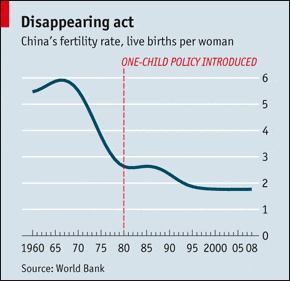
This past week China announced the end of its policy that limited most families to one child. Now it never was a strict limit, rural residents could have a second child if the first was a girl, and minorities were exempt altogether. But when it was first implemented in 1980, most women still wanted more than the permitted number, and the policy was draconian, indeed horrific, with women dragged away to undergo forced abortions and (slightly less horrific) forced sterilizations. For a decade, though, it's been irrelevant, as Chinese women are no longer farmer's wives who marry early and view multiple children as an inexpensive source of labor. Now urban women see children as an interruption to earning money, and costly to raise and educate.

In the background, the formation of the People's Republic in October 1949 brought an end to a century of almost continual civil war, including the Taiping Rebellion in the 1860s that led to perhaps 25 million deaths. The impact of the Japanese occupation in World War II was also horrific, in large part because it disrupted agriculture in the most productive parts of the country. So with peace after 1950, couples were both willing and able to raise children, and population growth rose. Fearing nuclear war with the Soviet Union, in the 1960s Chairman Mao actually encouraged large families. The problem was food. By the 1970s, the industrialization policies under Mao led to a sharp rise in fertilizer output, and pesticides and herbicides too, as the chemical industries expanded. Enter the Green Revolution, with "dwarf" varieties of rice and wheat that wouldn't grow tall and flop over when fertilizer was used. So in the 1970s the population ate a lot better, but the new leadership feared that was a one-time increase that would be eaten up over time. Hence fertility restrictions.

        In fact agricultural productivity kept improving. Today the public health challenge isn't dealing with undernourished children, it's dealing with the consequence of too much food, obesity and diabetes. Now environmental issues are affecting grain yields, but famine is no longer a realistic worry. Oh, and while the popular view attributes agricultural improvement to the breakup of the communes and the restoration of family farming, yields began growing well in advance of such institutional changes. It's not that the "Household Responsibility System" that gave land to the tillers didn't matter. But it mattered because it allowed families to send their children to the cities to work, and to shift their attentions from growing corn, wheat and rice to vegetables, pigs and fish farming.

But was this policy effective? In the early 1980s it certainly was, and it remains wildly unpopular today. Ending it, though, is now irrelevant, because on average women don't want large families. Most of the population now lives in cities – those who remain in the countryside tend to be old – so children are no longer useful as farm labor. Plus farmers now have better tools, herbicides take care of weeding and threshers handle the harvest. Compulsory education also means families have to support children for a longer period than in the past, and if parents want their children to do well they need more than the minimum education. With the growth of financial markets, it's now possible for families to save for their old age by putting money in the bank – Chinese save a lot, 25% or more of income. Even in the face financial scams and pyramid schemes, that's more reliable than depending on a single child who might turn out to be a prodigal daughter who only looks after her in-laws. Of course many couples want children, the social and biological impulse remains. But overall the benefits of having children are lower.

Meanwhile, the cost of children has risen. Women not only work off-farm jobs, but over time the past 25 years those jobs paid better and better wages. Having children means lost income, unlike when a wife could combine farmwork and child rearing. Furthermore, education is universally viewed as important. Even though compulsory education is now free, that's not enough to do well, and education doesn't come cheap, at least relative to incomes. Likewise healthcare is more costly, and with higher incomes overall, kids want fashionable clothes, not hand-me-downs. So the costs of children are up, indeed up a lot.

So with lower benefits and higher costs, Chinese families don't want two kids. This isn't just hypothetical. Fertility was falling sharply even before 1980, and was below the magic "two" number in urban areas as early as 1970. Demographers have examined the behavior of individuals for whom the policy wasn't binding, who were allowed to have more children. Many don't, the evidence is pretty clear that on average families want fewer than two children. So from the perspective of population growth, ending the one-child policy is a cheap shot. But there are plenty of couples who want two or more children, and for them this is a really good change, even if for China as a whole the policy no longer matters.

Now with smaller family sizes from 1980, the number of young women today has also fallen. Meanwhile, longevity has increased and with better nutrition and access to clean (bottled!) water that is set to continue. The biggest age bracket in the population are those in their late 40s. Already the working age population is falling, and by the early 2020s the overall population in China will be in decline even as the number of elderly is rising. That's today's worry, that the number of workers per retiree is set to fall sharply.

The policy change is however too late to make a difference. Even if today's young women start popping babies at double the rate of their mothers, there just aren't enough young women for that to have a big impact. It would be only when those new babies in turn become mothers (and their brothers workers) that the ratio of 20-64 year olds to those 65 and above will start improving. I've run simulations: that won't happen until 2063, a full half-century from now.

For my simulations, I used the age distribution of women in 2013 (see the population pyramid above), the age-specific fertility rate for women for 2013 [both from the China Statistical Yearbook 2014, and mortality from the WHO life tables, which matters for the old-age portion of the projections. I held fertility for young women (20-24) at a 50% increase, given the ongoing increase in education and work, but let that for the next two brackets (age 25-29 and age 30-34) double. I did not put in the likely decrease in mortality at older ages. Note that a 50% change in fertility in the space of 5 years represents a very fast pace of social change; doubling is even less realistic. My intent however is not to be realistic, but to ask how big and how soon the impact would be IF women start popping babies left and right. The asnwer: not much. There are a few more young Chinese in 2043, but a lot more old Chinese. Only in 2063 does the number of young Chinese rise enough to offset the aging of the population, and then it's not by a lot.
Age 20-64 pop to Age 65+ pop
YearRatio
20136.6
20185.2
20234.1
20283.5
20332.7
20382.2
20432.1
20482.1
20532.0
20581.9
20632.0

Addenda #1: Yellen in Congressional testimony noted that the time for interest rate hikes might be at hand. She has only 1 vote, and others have indicated they don't favor raising rates this year. Still, as Chairman of the Board of Governors her voice matters a lot. Accordingly, short-term interest rates are up, one-year bonds from 0.23% to 0.40% and 2-year bonds from 0.6% to 0.84%. Since current rates are zero, the interest rate next year has to jump a lot to give those yields, So the prediction incorporated into bond prices is for 1.25% rates for one-year bonds in 2017 and 1.75% in 2018."

Meanwhile the Donald lambasted Yellen for holding rates down. Why? – because it makes Obama look better. We probably ought not take too seriously what the Donald says, with his penchant for hyperbole and for saying what he thinks his audience wants to hear. As a businessman he surely knows that higher rates hit construction harder than most sectors of the economy, and that means eliminating a lot of non-elite jobs. Doesn't he think that a president ought to care about average Americans? Cynically, higher rates do boost incomes for the ultra-rich, and I'm sure he hears from his billionaire friends about the harm lower rates are wreaking. But I frankly doubt Trump is being that calculating when he steps in front of a CNN camera.

Addenda #2: Our moderator Jim Bresnahan asked why we haven't seen Chinese cars in the US. Now the industry there is the biggest in the world. It's sophisticated, to: the leading firm (given VW's problems) is GM. The head of GM's operations is Chinese, and with 2,000 engineers in Shanghai the R&D is increasingly done there. But until this year the leading firms in the market couldn't build cars fast enough. Profits were higher in China than elsewhere, too. So why export? We'll see that change, with Honda and GM and others shipping cars overseas. But the auto industry is global in its reach, and most cars are built where there's sold for reasons of cost and market fit. Furthermore, costs in China aren't low, the computer chips and software and paint and specialized steel for auto bodies cost the same everywhere. We won't see huge numbers of cars washing up on our shores from the other side of the Pacific.

Addenda #3: From this year the United Way of Rockbridge supports the Natural Bridge Food Pantry. For many years it operated quietly, with one local resident supporting them financially. He's passed away, so they are working to expand their funding base. As we go into winter, when many older residents of the Rockbridge area face the choice of medicine and food versus heat, the food pantry provides a crucial safety net. For more information, or to click to donate, go to the UWR web site at uwrockbridge.org.

Thứ Ba, 3 tháng 11, 2015

An ADAS glossary for the acronym challenged

If you’ve got ACD, you’ve come to the right place.

Paul Leroux
Someday, in the not-so-distant future, your mechanic will tell you that your CTA sensor has gone MIA. Or that your EDA needs an OTA update. Or that the camera system for your PLD has OSD. And when that day happens, you’ll be glad you stumbled across this post. Because I am about to point you to a useful little glossary that takes the mystery out of ADAS acronyms. (The irony being, of course, that ADAS is itself an acronym.)

Kidding aside, acronyms can stand in the way of clear communication — but only when used at the wrong time and place. Otherwise, they serve as useful shorthand, especially among industry insiders who have better things to do than say “advanced driver assistance system” 100 times a day when they can simply say ADAS instead.

In any case, you can find the glossary here. And when you look at it, you’ll appreciate my ulterior motive for sharing the link — to demonstrate that the ADAS industry is moving apace. The glossary makes it abundantly clear that the industry is working on, or has already developed, a large variety of ADAS systems. The number will only increase, thanks to government calls for vehicle safety standards, technology advances that make ADAS solutions more cost-effective, and growing consumer interest in cars that can avoid crashes. In fact, Visiongain has estimated that the global ADAS market will experience double-digit growth between 2014 and 2024, from a baseline estimate of $18.2 billion.

And in case you’re wondering, ACD stands for acronym challenged disorder. ;-)

Thứ Tư, 28 tháng 10, 2015

Five reasons why they should test autonomous cars in Ontario

Did I say five? I meant six…

Paul Leroux
It was late and I needed to get home. So I shut down my laptop, bundled myself in a warm jacket, and headed out to the QNX parking lot. A heavy snow had started to fall, making the roads slippery — but was I worried? Not really. In Ottawa, snow is a fact of life. You learn to live with it, and you learn to drive in it. So I cleared off the car windows, hopped in, and drove off.

Alas, my lack of concern was short-lived. The further I drove, the faster and thicker the snow fell. And then, it really started to come down. Pretty soon, all I could see out my windshield was a scene that looked like this, but with even less detail:


That’s right: a pure, unadulterated whiteout. Was I worried? Nope. But only because I was in a state of absolute terror. Fortunately, I could see the faintest wisp of tire tracks immediately in front of my car, so I followed them, praying that they didn’t lead into a ditch, or worse. (Spoiler alert: I made it home safe and sound.)

Of course, it doesn’t snow every day in Ottawa — or anywhere else in Ontario, for that matter. That said, we can get blanketed with the white stuff any time from October until April. And when we do, the snow can play havoc with highways, railways, airports, and even roofs.

Roofs, you say? One morning, a few years ago, I heard a (very) loud noise coming from the roof of QNX headquarters. When I looked out, this is what I saw — someone cleaning off the roof with a snow blower! So much snow had fallen that the integrity of the roof was being threatened:


When snow like this falls on the road, it can tax the abilities of even the best driver. But what happens when the driver isn’t a person, but the car itself? Good question. Snow and blowing snow can mask lane markers, cover street signs, and block light-detection sensors, making it difficult for an autonomous vehicle to determine where it should go and what it should do. Snow can even trick the vehicle into “seeing” phantom objects.

And it’s not just snow. Off the top of my head, I can think of 4 other phenomena common to Ontario roads that pose a challenge to human and robot drivers alike: black ice, freezing rain, extreme temperatures, and moose. I am only half joking about the last item: autonomous vehicles must respond appropriately to local fauna, not least when the animal in question weighs half a ton.

To put it simply, Ontario would be a perfect test bed for advancing the state of autonomous technologies. So imagine my delight when I learned that the Ontario government has decided to do something about it.

Starting January 1, Ontario will become the first Canadian province to allow road testing of automated vehicles and related technology. The provincial government is also pledging half a million dollars to the Ontario Centres of Excellence Connected Vehicle/Automated Vehicle Program, in addition to $2.45 million already provided.

The government has also installed some virtual guard rails. For instance, it insists that a trained driver stay behind the wheel at all times. The driver must monitor the operation of the autonomous vehicle and take over control whenever necessary.

Testing autonomous vehicles in Ontario simply makes sense, but not only because of the weather. The province also has a lot of automotive know-how. Chrysler, Ford, General Motors, Honda, and Toyota all have plants here, as do 350 parts suppliers. Moreover, the province has almost 100 companies and institutions involved in connected vehicle and automated vehicle technologies — including, of course, QNX Software Systems and its parent company, BlackBerry.

So next time you’re in Ontario, take a peek at the driver in the car next to you. But don’t be surprised if he or she isn’t holding the steering wheel.


A version of this post originally appeared in Connected Car Expo blog.

Walmart overseas: why so poor a performance?

Mike Smitka

Let me follow up on my previous post on Walmart's strategic challenges. There I noted that Walmart has been singularly unsuccessful in many of the markets it tried to enter. The "why" is my focus below.

Within economics and management there's a strand of research called "population ecology," spearheaded by the work of Glenn Carroll and Michael Hannan. They begin with a simple model: that early in its history an industry is populated by numerous firms with varying business strategies and management structures and operational setups. Some of these are ill suited to the competitive environment and disappear; others are a better fit and grow. These don't always scale. In my region of the US barbecue restaurants take a standardized form, a standard business model has evolved, but franchising doesn't seem to work.

I contend that the same is true for retail. In Japan at least 4 different national firms tried variations of the large-format, low-margin, high-volume retail store, and there are likely others that did so but failed before reaching a scale where I learned of them. (I know of a couple that appear to fit the mold but are limited to one or another region.) For example, while it claims a century-plus history, today's Jusco chain began in rural Japan, and expanded based on rural stores at the intersection of major roads. Even better, they were often able to do so outside of then-existing city boundaries, and so either were not regulated under the [now defunct] Large Store Law, or had only a small number of retailers on a town's main street who had to acquiesce to their setting up shop. I lived briefly in rural Niigata Prefecture, where there was a store as part of a mall outside of Muikamachi, at the intersection of two main roads and just off an expressway exit. The flower shop, the fruit shop, a local liquor store and others either found space inside the main Jusco building, or in a row of shops just across the parking lot. All of this was tied to regional logistics centers and the growth of national and not just regional wholesalers. They could also direct source clothing from overseas; most of what was on their racks carried labels of origin from elsewhere in Asia. Having previously lived in urban Japan in a house situated on a street of mom-and-pop retailers [that on one side was run by a mom, on the other by a dad], I was used to shopping daily for small quantities, and of facing that day's selection of fish and vegetables, a function of what the owner chose on their last trip to a local wholesale market or the current sale from distributor from whom they bought most of their clothing. These stores were friendly, but not inexpensive, and they kept short hours; they were often long closed by the time I got home. The alternative was the department store at a major train nexus, a possible stop on the way home. But there was no way to take a full shopping bag on a train during the Tokyo rush hour... So it was mind-blowing to drive to a mall in Japan, park my rental car and get out to find a huge store with copious variety and low prices.

Jusco and its rival Ito-Yokado chain filled the Walmart niche. They were intimately linked to the rise of new wholesale channels, they focused on markets where they faced no competition and lower capital costs, and from the beginning they built their businesses around modern inventory control systems and an ability to manage part-time workers to offer longer hours of operation. A third chain, Daiei, originated in urban areas. While it was for a while wildly successful, its focus on prime commuter-rail-based shopping areas left it with stores smaller in size and irregular in format – their layout and location were subject to the availability of a tract of land or an empty building of suitable size. In the process of expanding they accumulated a lot of debt, and ultimately went through a forced restructuring that left them under the control of the holding company of the Aeon chain, the parent to Jusco.

In short, by the time Walmart turned its attention to Japan, incumbent Japanese firms already occupied their strategic space: large-format rural "hypermarkets" open long hours that were in locations convenient for car-based shopping, buttressed by a strong position at the wholesale end, supported by management information systems and dedicated warehousing and logistics that gave them greater control over their sourcing and control of their inventory. While Walmart had a far bigger purchasing budget on a global basis, only some of what they'd order for US customers was appropriate to Japan, and they didn't have dedicated channels from their sources in China and elsewhere to store shelves in Osaka or Tokyo. Nor did they have sourcing for vegetables and other goods with short shelf lives. So while they did purchase the Seiyu retail chain, it was an older one with urban origins and a weak presence in the new car-based suburbs of Tokyo, and virtually no rural footprint. The store local to me in Inage, Chiba was a train stop (or 7 minute bike ride) away, but was small, and on a side street adjacent to a train station with room for only 4 cars to park. Yes, its price for peanut butter was great, but its vegetables were not, and the layout was impossible, I had to negotiate narrow stairs into a dingy basement. In contrast I could ride my bike in a different direction to an Aeon store that was bright, airy and had an adjacent food court and several other restaurants. It was also open both earlier and later, and off of two major roads with an attached multistory parking deck. And in another direction was a full shopping mall, a full kilometer in length on a major road, with parking for 2,000 cars and two hypermarkets facing each other. [Apparently when the developer told these stores they'd be "an anchor store" they heard they'd be "the anchor store" – great for shoppers, not so good for the stores!]

A final point: it wasn't just Walmart that tried and failed, but also the French giant Carrefour. They were more careful than Walmart, with better locations and larger footprints and parking garages for their stores. They still faced an uphill battle. Unfortunately they chose to advertise themselves as a French retailer. Japanese shoppers went in expecting fashionable clothes and accessories, unusual foods and a good selection of wine. What they found was a Walmart-like experience. By the time Carrefour realized its branding disconnect, it was too late.

To sum, 30 years ago "pre-modern" retail in Japan – and in Germany and France and the UK – was populated by a lot of entrepreneurial players. A few of them hit on the Walmart strategy, and of those some were analytic enough to realize why they were doing well, and grow. Carrefour and Tesco and Ito-Yokado and Metro and their peers have their strengths and weaknesses relative to Walmart. In the end, though, they're sufficiently strong and cover enough of their domestic markets to close off cross-border entry to the likes of Walmart. Unlike in their formative years, international expansion offers no low-hanging fruit ripe for outsiders to pick, be they a Walmart or a Kaufmarkt.

So what is it about Trader Joe's? They [and their sister operation Aldi] are to my knowledge the only foreign retailers in the grocery store segment in the US. Has TJ been able to cross other retail borders?

Thứ Năm, 22 tháng 10, 2015

The Economics of Strategy: Walmart's Senescense

Michael Smitka

Washington and Lee University

October 22, 2015 WREL Update

Today there's no "news" – nothing in the latest economic data is (to me) surprising – so instead I'll speak on topics tied to my teaching, and close with a brief note on United Way of Rockbridge. This term I'm teaching three very different classes, a senior "capstone" focusing on modern macroeconomics, a course on China's economy, and the other on the economics of business strategy. On air I spoke on two topics. One was Walmart as an exemplar of strategy. Yesterday I also "taught" a paper of Milton Friedman's, and so I started a multiweek series examining the evolution of "rules versus discretion" in policymaking. But for this blog post I'll limit myself to Walmart.

...Walmart is left as a bottom-feeder…

First, Walmart's strategy was to use economies of scale to gain a competitive advantage in its initial market, rural America. As long-time residents of the Rockbridge area will recall, Lexington used to have a hardware store on a prime piece of Main Street. There's still a building supply business a couple blocks away, back near W&L's Lenfest Center, across from where the railway station was located, back in the days when every town had train service. Buena Vista still has a couple hardware stores, and in Lexington there's one off of Nelson Street, behind Wendy's and Frank's Pizza (which I like), and the Rockbridge Farmer's Coop at the south end of town.

As hinted at, the geography of hardware stores, and the local dry goods store and so on, dated back to when roads weren't particularly good and many people lacked cars. Such stores had a local monopoly albeit in a market of limited size; they didn't discount. Their focus on a local market meant they carried a restricted range of goods, so you might have to order what you needed. Their competition was not internet sales, but the Sears, Roebuck and Company catalog, which provided parcel post delivery that might prove cheaper than your local store, and offered a huge array of products that a small town retailer couldn't begin to touch. (Aside: only later did Sears move to brick and mortar – will history repeat, with Amazon stores in every town?)

Walmart took advantage of better roads and pervasive car ownership to set up larger stores with greater variety, and to use scale to allow it to offer these at a lower margin. It could staff lightly, by locating outside of towns it could manage its real estate costs while providing better parking and road access, and it chose to offer hours far longer than those of any downtown retailer. Call these economies of scale plus the ability to push against the operating limitations of small town retailing. In addition Walmart offered greater convenience by carrying in one location what would in general have been spread across several stores – basic clothing, hardware, and other "hard" goods. Eventually this expanded to include a pharmacy, groceries (with the launch of Supercenters in 1988) and a full line of consumer electronics. No single department could match those of a specialty retailer, and you couldn't get the service provided by the local hardware, which could advise on tools and materials. But a large proportion of sales volume was of common items where customers didn't need (and maybe didn't want) such service. And there was the convenience: quick in and out for three items, which might have required you to visit three stores downtown during the busiest part of your day. This we could term economies of scope.

Walmart pushed this strategy for their first couple decades, gradually expanding across rural America while avoiding suburban locations. (You still can't find Walmart in urban locations – they have zero stores in Detroit, zero stores in New York City.) They faced no competitors. K-Mart, for example, began as the Kresge Five-and-Dime chain, located in big cities, and gradually expanded to the suburbs. They never managed that transition well, the operational efficiencies never matched those of Walmart. Sears set up stores in urban areas, and then expanded to malls, but was unable to leverage its catalog strengths to create a distinctive bricks-and-mortar strategy in rural areas.

Walmart also offered operational efficiency. In the retail world, their management information system was matched only by that of 7/11 in Japan. When you went to Walmart, you could find what wanted; they did not stock out. In contrast, with K-Mart you could never be sure they'd actually have what you wanted on their shelves. Their stores were smaller, carried a narrower range and otherwise were not up to their competition, and in particular to Walmart.

Once Walmart had filled rural America, however, they started losing steam. While they were better than K-Mart, they did face competition. Real estate was more expensive, and urban consumers were more prosperous and had varied tastes. Walmart couldn't tap the full breadth of the population, and instead had to bottom-feed. In addition, expansion slowed.

...senescence will be followed by debility...

Meanwhile they'd become a mature big business, with a headquarters staffed by professionals in finance, marketing and other functions – that is, not staffed by people with hands sullied from initially working retail. They brought new ideas and technicals skills, but not necessary better ideas, or the ability to understand how their expertise contributed to the overall position of Walmart. In short, they could optimize their narrow function while losing sight of what the business was about.

That structure in general meant more rules and regulations, and less delegation of authority. Our local store can't readily adjust staffing when local conditions give them busy periods other than those built into regional and national operating plans. Ordering is at the regional level; garden supplies come in line with the growing season in Richmond and Virginia Beach, which means inventory arrives too early in the season to plant. All of this works to the advantage of smaller retailers more attuned to our area, or focused retailers (Lowes).

Then there's the stock market growth imperative, that each quarter ought to have higher profits than the preceding one. Why management should respond to this is not so clear. Some comes from the perverse incentives that pay and bonuses are more closely linked to scale than to profit margins. Put simply, it's better in pay and prestige to be an exec in a big business than a medium-sized one. At some point, though, Walmart scaled out, and additional expansion leads nowhere, or nowhere good. Walmart tried the international side, and lost billions in Germany, Korea and Japan, among others. (While they exited from Germany, they maintain ownership of the Seiyu chain in Japan, most of whose stores are small and in poor locations for today's suburban, car-driving population.) My sense is that they do well only in Mexico and secondarily in Canada, due to organic expansion. In other countries they tried the acquisition route, and so were unable to leverage such strengths as their US experience might afford. We'll see how they do in China...

Now if organic expansion is slow – adding a store doesn't add a visible amount to sales – and the merger and acquisition route has hit a dead end, then the only route remaining is to cut costs. When your business model was based from the start on low costs, that requires cutting services. Staffing means shelves don't get restocked, and checkout lines can be unbearably long. Middle management is cheapened, without authority you don't have to spend time on hiring and training good people, or encouraging those you have to develop in their jobs. All of this rebounds into a poorer customer experience.

And I see no way out. There's no room for expansion geographically. Higher-margin goods face the rise of online retail. Specialty chains and Target pull away the more desirable customers, aided and abetted by the shopping experience Walmart provides. So Walmart is left as a bottom-feeder. While they could spend more, that would hurt profits for a period of years, and might not be well-managed if those in Bentonville want to remain as decision makers. While I'm not aware of any retail concept that might eat into Walmart's core rural markets, I'm afraid that the management focus on growing profits means they will be neglected, with a cumulative impact on their profitability. My expectation is that senescence will be followed by debility.

================


================

For 2016 United Way of Rockbridge will provide grants for 22 projects to be undertaken by 18 community-oriented non-profits. One focus are critical needs such as food, shelter, and assistance to the disabled. Our other focus is on having a positive long-run impact on our community through improving the preparation of children for kindergarten and elementary school. Note that to be useful to these groups, who have to draw up their budgets and operating plans, we have to make our funding decisions well in advance of when we actually hand out money. So any amounts I mention are for CY2016.

Each week I'm speaking briefly about one of these organizations; today it's Campus Kitchen at Washington and Lee. They began in 2008, and work with the dining services of Washington and Lee, Virginia Military Institute, Carilion Stonewall-Jackson Hospital, and Walmart to see that food does not go to waste. To date they've repurposed 200 tons of food to provide almost a quarter million meals to families in the Rockbridge area. During the course of the year, they'll typically get over 300 individuals volunteering to collect and repackage food and for certain groups whom they serve, to cook meals.

This coming year UWR will fund two projects. One is $2,000 for their "backpack" program in cooperation with local schools, in which they send groceries home with children whose families face challenges in putting food on the table. The second project is $2,000 for their mobile food pantry, which provides food to outlying areas of the county that are not near any of the existing food pantries.

As with other projects, we evaluate their paper application, and then arrange for two reviewers from the community – volunteers including but not limited to members of the United Way board -- to visit each group. Unfortunately we can seldom provide groups with all the money they request; we instead strive to allocate to generate a good impact for the money we can allocate.

Later in the fall I'll have information on the progress of our 2015-16 Annual Campaign, which seeks to raise $250,000, slightly more than we managed last year. Please consider helping us toards our goal of "Building a Caring Community". Some of you will receive appeals through your employer. Even a dollar per pay period is meaningful – the groups we support leverage volunteers and other resources, so that even seemingly small amounts make a difference to someone. More generally, please visit our web site. You can use our "Donate Now" function to make a contribution with a credit or debit card. It's secure – we never see your card number, and the data isn't stored. We also provide details on our grants, our finances and Board. And our address, in case you'd like to contribute by check...