Thứ Ba, 23 tháng 8, 2016

QNX's Fabulous Concept Cars


Thomas Bloor
Business Development Manager, BlackBerry

If you’ve been to CES chances are you’ve seen one of our concept cars, even if you’ve not been to our booth, we take these to our industry partners. Now as we start gearing up for next year’s CES there are some great innovations in the pipeline. (I’ve seen them, but I’m not telling.) So as I can’t spill the beans on what's coming, but let’s take a look at some of my favorite QNX Concept Cars from years past.


The Porsche 911 Carrera (CES 2012)
Admittedly I have a soft spot for performance cars, but the Porsche deserves headline billing in the roster as a CNet "Best of CES" winner. With revolutionary (for 2012), cloud-based voice recognition you could control the navigation system using natural language.   And, text-to-speech meant that you could listen to incoming BBMs, emails and text messages. Rounding out the roster of features that would still be considered ahead of the curve for a production car today, this model featured one-touch Bluetooth pairing.  Simply touching your phone to an NFC reader in the center console automatically paired the phone and car. 


The Bentley Continental GT (CES 2013)
In an outburst of Canadian quirkiness, we decided that when better to do a photoshoot of a Bentley Convertible than in the middle of the Canadian winter? Of course despite the -20C (-4F) weather we’d have to have the top down!

The cold and the snow do not detract from the revolutionary center stack with DLP® display from Texas Instruments. This immense (for 2013) featured an organically curved surface and TI’s optical touch input technology, which allowed physical control knobs to be mounted directly on the screen resulting in an ideal balance in physical and touchscreen controls


Taking natural language voice recognition a step further we worked with AT&T’s WatsonSM . Say "Hello Bentley," and the car's voice recognition system immediately starts interacting with you, in a distinctly British accent, old chap.


If that weren’t enough, the cluster displays the back-up camera and user configurable high resolution instrumentation. We also took the mobile office to new heights with smartphone integration with streaming music, email notification, news feeds, and other real-time information. Put the Bentley into park and you could fire up video conferencing with realistic telepresence.  

Separate cameras for the driver and passenger provide independent video streams, while high-definition voice technology from QNX offers expanded bandwidth for greater realism, while stereo telepresence makes the remote caller sound as if they’re sitting right next to you.


Mercedes CLA 45 AMG (CES 2014)
Have you looked inside a Mercedes S class recently? The horizontally orientated center stack display extends across the dash. Coincidentally our 2014 Mercedes concept had a 21-inch-wide center display extending towards the passenger enabling a seamless interaction with the vehicle.
 
Behind the scenes the Cluster was integrated with the center stack running both driver information and IVI functions. With seamless controllability across the touch screen, physical buttons and the jog wheel controls multi-modal input was highlighted across all available functionality. 

Not content with that, we foreshadowed greater integration of ADAS functionality warnings to the driver through both the cluster and verbally through text to speech if the local speed limits were exceeded.

Jeep Wrangler and Toyota Highlander
Now it’s not all high end luxury cars, which is just as well because they never let me drive any of them. Our Jeep Wrangler and Toyota Highlanders serve as our QNX reference vehicles showcasing what the QNX CAR application platform can do, straight out of the box. Additionally, the Toyota features our advances in in-car communication and acoustics platforms enabling an enhanced user experience for drivers and passengers.

These cars are not just  "show floor wonders" because our automotive knowledge enables us to build demonstrators for the real world, which can be driven, and the technology can be experienced first-hand. Concept clusters and displays abound, but real vehicle bus integration means these cars are drivable with real instrumentation and connectivity.


While I can’t reveal what new exciting technologies we are planning for CES 2017 (believe me, you’ll want to come and take a look), I can say that our reference vehicles are currently on tour so keep an eye open for them on the roads near you.


Thứ Sáu, 19 tháng 8, 2016

Durable Goods and Used Car Prices

cargraph

Elizabeth Platt, May 2016. Reposted from the Econ 244 site.

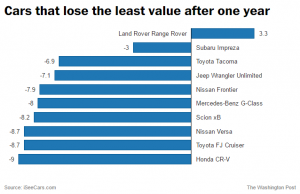
As discussed in class, an automobile value depreciates as soon as it’s driven off the lot. A recent study using iSeeCars.com puts a number to that depreciation. Analyzing 15.7 million cars over the course of the year, the study finds the average car value loss is 17% of its value in the first year. However, individual models differ in their value loss. At the top of the spectrum, the Hyundai Genesis loses 38.2% of its value in the first year.

The study cites demand as a function of reliability, popularity compared to competitors, dependability, repair costs, and redesigns. Thus, many of the factors the study believes determine demand cannot be estimated until at the time of the purchase, making resale value more difficult to gage. The drop in value after the first year corresponds to a potential savings of $16,000 if the consumer purchases a slightly used model. Consumers have the option of buying a new car with little knowledge of its reliability or waiting a year to purchase a slightly used car with more information in one hand and savings in the other. One significant part of demand, though, is aesthetics. By waiting for a slightly used car, the consumer runs the risk the manufacturer may introduce a newer model. In a society centered on “keeping up with the Jones,” newer models make the option of a slightly used model unappealing to some consumers. On the other hand, not all cars depreciate at this magnitude, making a slightly used model less of a deal. The study found some models lose less than 10%, such as the Subaru Impreza which lost just 3% of its value in the first year. In the end, knowledge concerning the difference in value of a new and a used car can be extremely beneficial for the consumer.

UsedCarsSource: https://www.washingtonpost.com/news/get-there/wp/2015/01/21/the-best-bargains-for-buyers-looking-for-lightly-owned-used-cars/

...there is no such thing as a new car...

Chart by the Prof using data from the auto auction firm Adesa. These data are raw averages of varying mixes of vehicles. Tom Kontos, their chief economist, analyzes this in much greater detail, by brand, like-vehicles, with seasonal corrections and on and on.


The Prof's comments: This is a neat topic, because the physical depreciation of a car is different from the economic depreciation. It is also at least in part a strategic variable that car companies can influence, through adjusting competition among vehicles in their model lineup and the timing of new model introductions and (as noted below by Michael Adams) fleet sale and leasing policies.
The overall declining trend is a reflection of the Great Recession: no leasing and few sales of new cars and lower incomes led to a dearth of used vehicles amidst greater demand for generally less-expensive used vehicles. That effect lingers but has largely worked its way through the system. You can though see changes by category, e.g. trucks vs smaller cars. I don't know the impact of interest rates on the "yield curve" of cars. Lower rates make both bought-new and bought-used cars less expensive, at least for purchasers who are thoughtful about their financing options. Companies such as ALG that are involved in leasing surely model that. My hunch is that the income effect – higher purchasing power – offsets the substitution effect so that there is no net impact.

Comment by Michael Adams: This article helps to explain why firms, notably General Motors, have begun to scale back on fleet vehicles. The slightly used fleet vehicles, depreciated during their time of service, are quickly resold as used cars and compete with brand new models. Consumers can reap the benefits of a purchasing a gently used car if they are willing to wait for even a few months.

Murray Manley commented: I think this article is particularly interesting because it highlights the difference in some examples of consumer and producer preferences. For example, producers are always working on producing the next model and aiming to engineer the best car that matches or exceeds the car of competitors. This “keeping up with the Jones’s” in the producer and manufacturing world leads to increased profits- whoever can produce the best vehicle the fastest will ideally sell the most cars. On the other hand, while some consumers prefer to always have a new and fashionable model of a car, others cannot afford, don’t care about, or are unaware of style changes from year to year. In that respect, the customers who care less about new models benefit because slightly used cars will always be significantly cheaper if producers continue to come out with new models quickly.

Thứ Năm, 18 tháng 8, 2016

Security Matters for the Software-Defined Car


Bill Boldt
Business Development Manger, Security, BlackBerry
wboldt@blackberry.com

  
Certicom, the crypto expert in the BlackBerry Technology Solutions family is positioned to lead the way to a secure software-defined future for the automotive industry –because when it comes to the security, real-world experience matters.
 

Certicom is a recognized leader in public key infrastructure (PKI) security design,innovation, and delivery. PKI is a foundational technology that has become the cornerstone of real world security across the internet, mobile, medical, financial, government,military, consumer, automotive, industrial, IoT, and just about every application that communicates information electronically. 

Public Key Cryptography uses public-private cryptographic key pairs to sign digital certificates and provide the essential elements of security, which are confidentiality, data integrity, authentication, and non-repudiation. PKI establishes the infrastructure that defines how digital certificates are created, distributed, stored, and revoked.


Public Key Cryptography Matters

It is not at all an overstatement to characterize Public Key Cryptography as having established the main way that security is provided throughout today’s (and tomorrow’s) connected world. In fact, anyone who has ever logged on to a secure web site such as e-commerce or e-banking has used Public Key crypto, most likely without even knowing it. it is already built into personal computers and smart phones, and it won’t be long before it is built into every embedded application as well. And, that is a very important notion to grasp.


Proven PKI solutions from world leading software and security infrastructure suppliers like Certicom increase device (e.g. semiconductor chip and board) security, fight counterfeiting and cloning of products and firmware, promote product and personal identity authentication, secure asset management in supply chains, and improve the security of numerous other applications, including the emerging Internet of things (“IoT”).

    
Public Key crypto's tremendous growth is being increasingly driven by two powerful forces: 1) the widespread adoption of autonomous communicating devices, and 2) the realization that such devices absolutely must be authenticated.

Supply Chain Security Matters
The long pole in the tent for  security in the software-defined car is in fact securing the supply chain. 

Security assets (such as crypto keys, uniqueserial numbers, etc.) must be installed into the devices at manufacturing time.  Devices must be distributed to and installed into vehicles in globally located factories. Devices must be warehoused worldwide for subsequent repairs.  Secure devices must be updateable at the dealers and repair shops.  Aftermarket suppliers must be able to sell and update secure devices. These requirements present a logistical tangle. Making a device such as an ECU or secure processor secure means that it will be unique. 


However, by definition that device cannot be used anywhere else.  It becomes a unique stock keeping unit (SKU), which is averse to the purpose of flexible, just in time manufacturing flows.  Security versus flexibility is a serious trade off that must be managed carefully. To maintain the maximum amount of flexibility, personalization and updating should be moved as close as possible to the very last minute.   That means it must happen not only in the factory, but in the field and via updates.  Each car maker faces the same issues, and will have to design and manage a secure device manufacturing system, security certificate management system, and a secure updating system – all of which must be global and long term in nature.
  

These are the type of things that Blackberry can provide  based upon decades of experience in securing mobile infrastructure and devices, to a level that no other company has done.


Experience Matters

Security is as elemental to an electronic system as DNA is to an organism—and security is BlackBerry’s DNA.


For the connected autonomous car of the future-- security has to be inside and outside the car, in the supply chain,  and updateable.  BlackBerry has the state of the art experience to to those things due to proven experience in making products secure, in high volumes, and in the supply chain.